
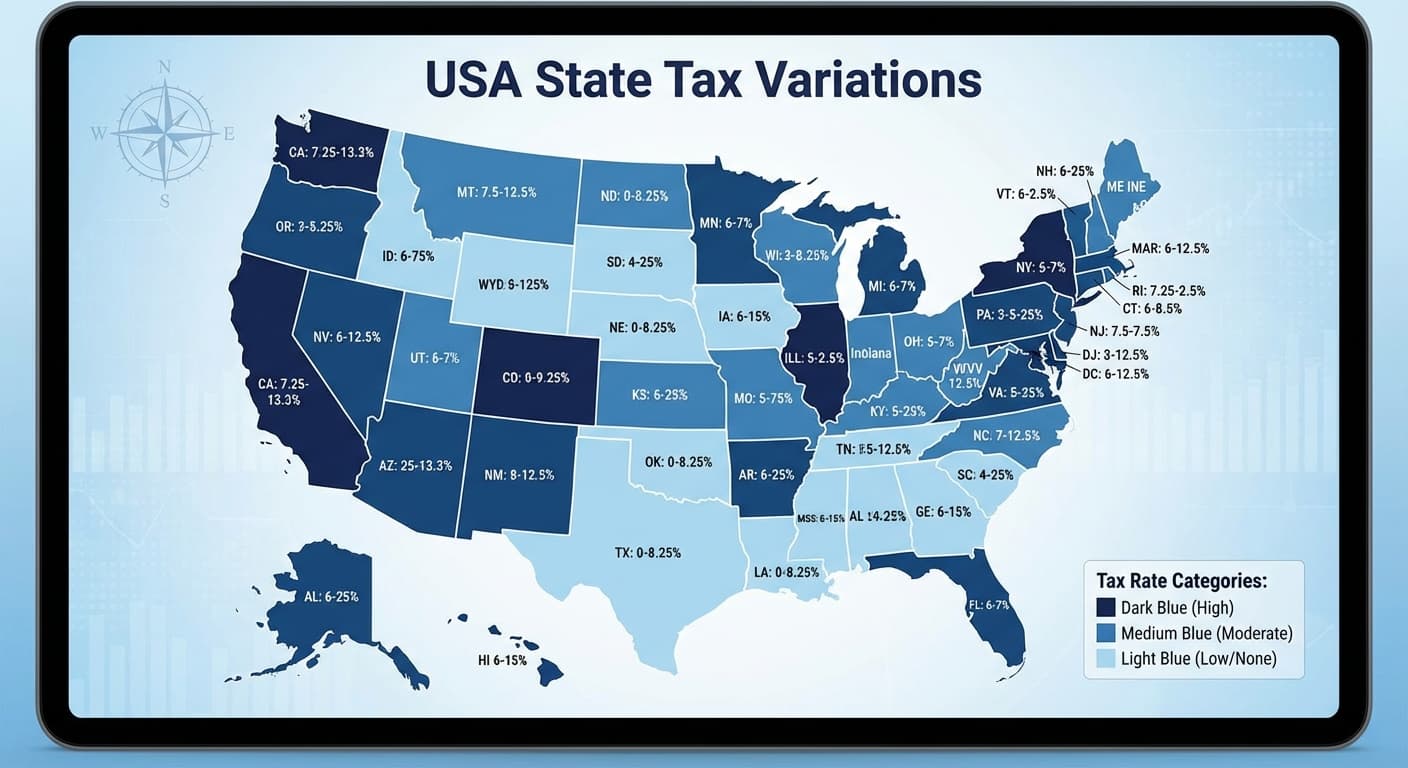
Understanding State Tax Differences Across the US
Published on January 2026
Paying $15,000 in state taxes while your friend in Florida pays zero? State tax differences can mean a 10-15% swing in your take-home pay for the exact same income.
The problem is that most people only consider federal taxes when evaluating jobs, relocations, or retirement moves. With some states charging 13%+ and others charging nothing, ignoring state taxes can cost you hundreds of thousands over a career. Remote work has made this even more complex—you might owe taxes to multiple states.
This comprehensive guide breaks down state tax differences across all 50 states—from no-income-tax states to the highest rates, plus property tax, sales tax, and retirement income treatment. You'll learn exactly how location affects your tax burden and strategies to legally minimize state taxes.
While federal income tax applies uniformly across the country, state taxes vary dramatically. Some states have no income tax, while others have rates exceeding 13%. Understanding these differences is crucial whether you're considering relocation, working remotely, or planning your tax strategy.
States Without Income Tax
Nine states don't impose income tax on wages: Alaska, Florida, Nevada, New Hampshire, South Dakota, Tennessee, Texas, Washington, and Wyoming. This can mean significant savings for high earners. However, these states often make up revenue through higher sales taxes, property taxes, or other fees.
New Hampshire and Washington have special cases—New Hampshire taxes interest and dividend income (though this is being phased out), while Washington taxes capital gains above $250,000 at 7%. Consider your full financial picture when evaluating no-income-tax states.
Highest State Income Tax Rates
California has the highest top marginal rate at 13.3%, applying to income over approximately $1 million. New York reaches 10.9%, New Jersey 10.75%, and Hawaii 11%. These high rates typically only apply to top earners, with lower rates for most income levels.
Some localities add their own income taxes on top of state rates. New York City residents pay an additional 3.876%, and several other cities and counties across the country impose local income taxes. Research both state and local taxes when evaluating your total tax burden.
Progressive vs. Flat State Tax Systems
Most states use progressive tax systems with multiple brackets, similar to federal taxes. Tax rates increase as income rises. Other states use a flat tax—a single rate regardless of income level. Colorado, Illinois, Indiana, Kentucky, Massachusetts, Michigan, North Carolina, Pennsylvania, and Utah use flat tax systems.
Flat tax states often have competitive rates—North Carolina at 4.5%, for example. Whether a flat or progressive system is better depends on your income level and the specific rates involved.
Sales and Property Tax Considerations
States with no income tax often have higher sales or property taxes. Texas has no income tax but relatively high property taxes and a 6.25% state sales tax (up to 8.25% with local taxes). Florida has no income tax but a 6% sales tax and property taxes that vary by county.
Total tax burden matters more than just income tax rates. A state with moderate income tax but low property and sales taxes might cost less overall than a no-income-tax state with high taxes elsewhere, especially for middle-income households.
State Tax Treatment of Retirement Income
States differ dramatically in how they tax retirement income. Some states don't tax Social Security benefits, while others fully tax them. Many states provide special exemptions or deductions for pension income and retirement account withdrawals.
Retirees should carefully consider state tax treatment of retirement income. Moving to a state that doesn't tax Social Security and pensions can significantly extend retirement savings. Popular retirement destinations like Florida, Arizona, and Nevada offer favorable tax treatment for retirees.
Multi-State Tax Issues for Remote Workers
Remote work has complicated state tax situations. Generally, you pay income tax to your state of residence. However, some states have convenience rules requiring taxes on income earned remotely for employers in those states, even if you never set foot there.
If you live in one state and work in another, you typically pay tax to the work state and receive a credit from your home state to avoid double taxation. This becomes complex with multiple states or partial-year residency. Keep detailed records of where you physically worked throughout the year.
Establishing State Residency
Residency rules vary by state but typically depend on factors like where you maintain a permanent home, how much time you spend in the state, where your vehicles are registered, where you vote, and where you have professional licenses.
Some high-tax states aggressively audit former residents who claim to have moved to low-tax states. If you're moving to reduce taxes, thoroughly document your residency change—update your driver's license, register to vote, establish banking relationships, and file a final resident return in your old state.
State Tax Deductibility on Federal Returns
You can deduct state income taxes on your federal return if you itemize, but the SALT deduction is capped at $10,000 total for state and local income taxes plus property taxes. This cap particularly affects taxpayers in high-tax states with high property values.
The SALT cap has made state tax differences more significant since 2018. Previously, high state taxes were partially offset by federal deductions. Now, the full burden falls on taxpayers in high-tax states.
Frequently Asked Questions
Q: If I work remotely, which state do I pay taxes to?
A: Generally, you pay taxes to your state of residence (where you live). However, some states have "convenience rules" requiring you to pay taxes to the employer's state even when working remotely. New York, Connecticut, and Pennsylvania have such rules. Consult a tax professional for multi-state situations.
Q: Can I avoid state taxes by claiming residency in a no-tax state?
A: You must genuinely establish residency—spending 183+ days/year there, getting a driver's license, registering vehicles, voting, and having a permanent home. High-tax states aggressively audit former residents who claim to move to no-tax states. Maintain detailed records proving your residency change.
Q: How do states make up for no income tax?
A: No-income-tax states typically have higher property taxes, sales taxes, or specialized taxes. Texas has high property taxes and business franchise taxes. Washington has high sales tax and taxes capital gains. Florida has no income tax but relies on sales tax and tourism-related revenue.
Q: Which states don't tax retirement income?
A: Nine states have no income tax at all (including on retirement income): AK, FL, NV, NH, SD, TN, TX, WA, WY. Additionally, Illinois, Iowa, Mississippi, and Pennsylvania don't tax retirement distributions. Many other states provide partial exemptions or exclusions for retirement income.
Q: Do I get a tax credit if I pay taxes to two states?
A: Yes, your resident state typically provides a credit for taxes paid to other states to prevent double taxation. You'll file a non-resident return in the work state and a resident return in your home state, claiming a credit for the taxes paid to the work state.
Q: Should I move to a no-tax state to save money?
A: Consider total tax burden (income + property + sales), cost of living, job opportunities, and quality of life. A high-tax state with lower housing costs might be more affordable than a no-tax state with expensive real estate. Run the complete financial comparison before moving.
Q: What is the highest combined state and local income tax rate?
A: California has the highest combined rate—13.3% state + potential local taxes in some cities. New York City residents pay up to 10.9% state + 3.876% city = 14.776% combined. Add federal 37% + 3.8% NIIT for high earners, and total marginal rate exceeds 55% on ordinary income.
Q: Can I split my time between states to reduce taxes?
A: Yes, but carefully. Most states use a 183-day rule—spend less than half the year there and you're not a resident. Snowbirds often split time between high-tax summer states and no-tax winter states. Document your days meticulously with receipts, travel records, and phone GPS data in case of audit.
Your ZIP Code Is a Tax Decision—Choose Wisely
You now understand the 9 no-tax states (FL, TX, WA save 3-13.3%), highest-tax states (CA 13.3%, NY 10.9%), flat vs. progressive structures, property/sales tax trade-offs, retirement income treatment (some states exempt Social Security), and multi-state residency rules (183-day test). Where you live determines 10-15% of your take-home pay—that's not a detail, it's a major financial decision.
The difference between guessing and calculating? A $200K earner moving from California (13.3%) to Texas (0%) saves $26,600 annually in state tax. Over a 30-year career, that's $800,000+ saved—enough to fund a comfortable retirement. Even part-year residency strategies (snowbirds) can save $10K-$20K annually for those who track days meticulously.
Next step: Use our State Tax Calculator to compare your exact tax burden across all 50 states. Enter your income, filing status, and see side-by-side comparisons including income, property, and sales taxes. Model relocation scenarios before making the move.