
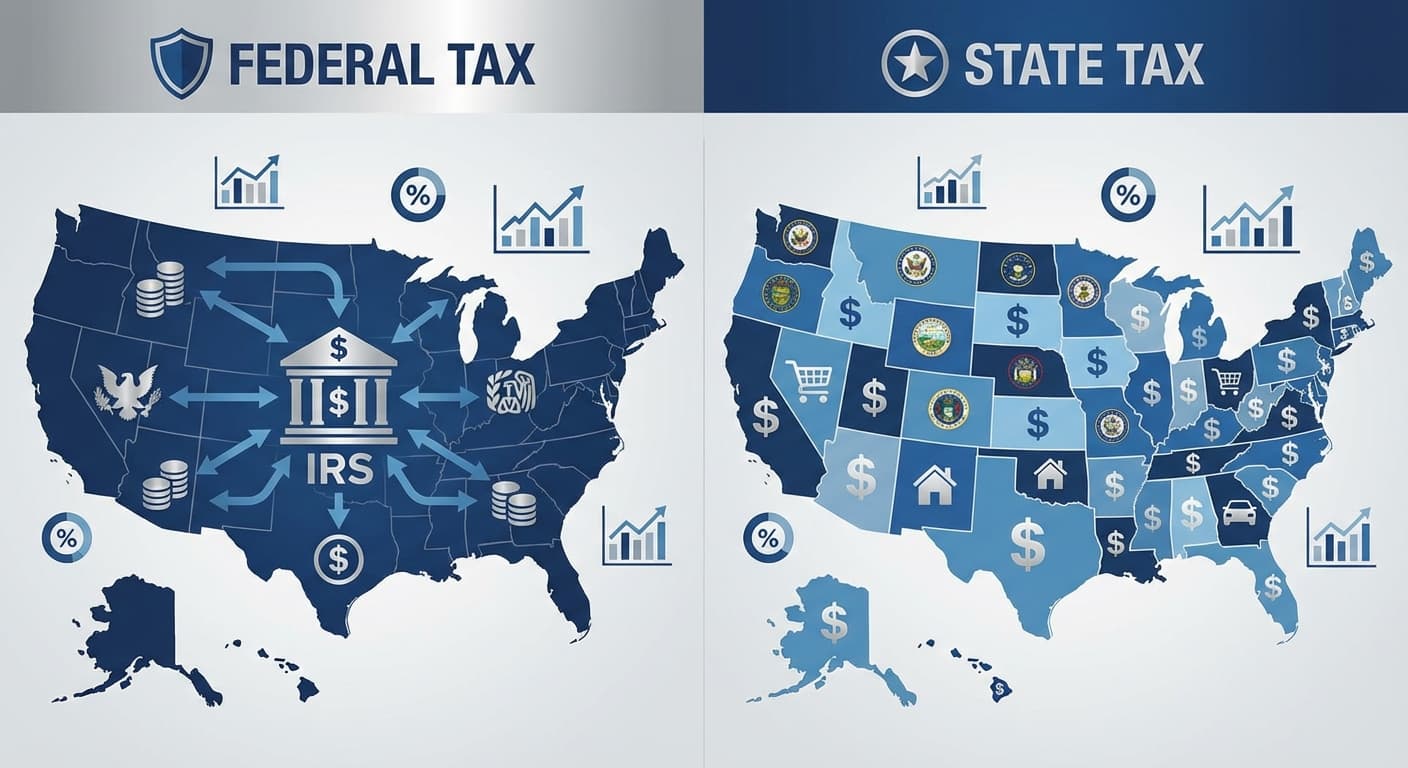
State vs Federal Tax Differences
Published on August 2026
Taxpayers often assume state taxes work like federal—and that mistake costs them thousands. You can't itemize federally and take standard deduction on state (most states), federal credits don't automatically apply to state, and moving mid-year requires filing TWO part-year returns. One wrong assumption—like thinking "I paid federal, so state is done"—triggers penalties, interest, and surprise tax bills.
The problem? 50 states = 50 different tax systems. Nine states have NO income tax (FL, TX, WA, etc.), California charges 13.3% (top earners pay 50.3% combined!), and some states tax retirement income while others exempt it. The $10,000 SALT cap limits federal deductions but doesn't reduce state tax owed. Plus, state rules on itemizing, credits, and filing requirements differ dramatically from federal.
This guide breaks down the key differences between state and federal taxes—and shows you how to optimize both. We explain the 9 no-tax states, progressive vs. flat state tax structures, SALT cap mechanics ($10K federal limit, unlimited state deduction), state-specific credits (not automatic from federal), part-year resident filing rules (2 state returns!), and combined marginal rates (CA top earners: 37% + 13.3% = 50.3%).
State and federal tax systems differ significantly in rates, deductions, and rules. Understanding these differences prevents errors and optimizes combined tax liability across both jurisdictions.
Tax Rate Structures
Federal uses seven progressive brackets from 10% to 37%. States vary: nine states have no income tax, others use flat rates (Colorado 4.4%) or progressive brackets (California 1%-13.3%). Rate differences create tax arbitrage through relocation.
Standard Deductions
Federal standard deduction is $14,600 single, $29,200 married for 2026. States set their own: some match federal, others use lower amounts, and some offer no standard deduction at all. Check state-specific rules.
Itemized Deduction Differences
Some states conform to federal itemized deductions, others add or disallow specific items. SALT deduction capped federally at $10,000 but may be unlimited for state purposes, creating reconciliation complexity.
Tax Credits Divergence
Federal credits (EITC, Child Tax Credit, education credits) may or may not have state equivalents. Some states offer unique credits for property taxes, renters, or retirement income. Don't assume federal credits apply to state.
Filing Requirements
Federal return due April 15. State deadlines usually match but not always. Some states don't require returns if income is below thresholds. Part-year residents and non-residents have special state filing rules.
Frequently Asked Questions
What states have no income tax in 2026?
9 states have NO income tax: Alaska, Florida, Nevada, South Dakota, Tennessee, Texas, Washington, Wyoming, and New Hampshire (no tax on wages, but taxes dividends/interest until 2026). Moving to these states can save 3-13.3% state income tax, but consider higher property/sales taxes and cost of living differences.
Do state tax brackets work the same as federal brackets?
No, each state sets its own structure. Federal: 7 brackets (10-37%). States vary: Flat tax (Colorado 4.4%, Illinois 4.95%), progressive brackets (California 1-13.3%, 9 brackets), or no tax (9 states). Some states have 2-3 brackets, others have 10+. Rates and income thresholds differ completely from federal.
Can I itemize on federal return but take standard deduction on state?
Depends on state. Most states require you to use same method (itemize or standard) as federal return. However, some states allow different choices or have no standard deduction at all. A few states (e.g., Alabama) allow itemizing on state even if taking standard federally. Check your state's specific rules.
What is the $10,000 SALT cap and how does it affect state taxes?
Federal SALT (State And Local Tax) deduction capped at $10,000 for state income taxes + property taxes combined ($5,000 married filing separately). This federal limit doesn't affect your actual state tax owed—you still pay full state tax. Some states offer workarounds (e.g., PTET pass-through entity tax), but consult CPA. SALT cap expires Dec 31, 2026 unless extended.
Do I need to file a state tax return if I file federal?
Not automatically. State filing requirements vary: Most states require return if income exceeds threshold (often lower than federal), 9 states have no income tax (no return needed), part-year residents must file in both states, non-residents file if they earned income in that state. Always check state-specific filing requirements.
What happens if I move mid-year between states?
File part-year resident returns in BOTH states: Old state (Jan 1 - move date income), New state (move date - Dec 31 income). Each state taxes only income earned while you were resident. Document move date with lease, utility bills, driver's license change. Some states have different residency tests—consult tax pro to avoid double taxation.
Are federal tax credits also available on state returns?
No, state and federal credits are separate. Federal credits (EITC, Child Tax Credit, education credits) may have state equivalents—but amounts and eligibility differ. Some states offer unique credits: property tax credits, renter credits, retirement income exclusions, solar/EV credits. You must apply for state credits separately on state return.
Which states have the highest and lowest income tax rates?
Highest: California 13.3% (top bracket), Hawaii 11%, New Jersey 10.75%, Oregon 9.9%, Minnesota 9.85%. Lowest (excluding no-tax states): North Dakota 2.9%, Pennsylvania 3.07%, Indiana 3.15%, Michigan 4.05%. Top earners in CA pay 37% federal + 13.3% state = 50.3% combined marginal rate on ordinary income.
Know the Difference—Optimize Both Federal and State
You now understand the 9 no-tax states (FL, TX, WA, etc.), progressive vs. flat state structures (CA 13.3% vs. CO 4.4%), SALT cap mechanics ($10K federal limit ≠ state limit), state-specific credits (not automatic from federal), part-year resident rules (2 returns!), and combined marginal rates (CA top: 50.3%). State and federal taxes are separate systems—treat them that way.
The difference between guessing and knowing? A CA earner making $500K who relocates to TX saves $66,500 annually in state tax (13.3% × $500K). A part-year resident who doesn't file both state returns faces penalties. Understanding state-federal differences saves thousands every year—and six figures over a career if you optimize location, timing, and deductions.
Next step: Use our free Tax Calculator to model federal AND state taxes side-by-side. Enter your income, deductions, and state to see exact combined tax liability. Compare states to see relocation savings. No surprises at filing time.