
Tax Loss Harvesting Guide 2026
Published on October 2026
Watching your investments lose value? While market downturns are painful, they create valuable tax-saving opportunities that most investors completely miss.
The problem is that without tax loss harvesting, you pay full capital gains tax on winners while unrealized losses sit in your portfolio providing no benefit. This leaves thousands of dollars in potential tax savings unclaimed year after year.
This guide reveals how to transform investment losses into real tax savings through strategic loss harvesting. You'll learn the exact process for offsetting capital gains, avoiding wash sale traps, timing your trades, and potentially saving thousands annually while maintaining market exposure.
What Is Tax Loss Harvesting?
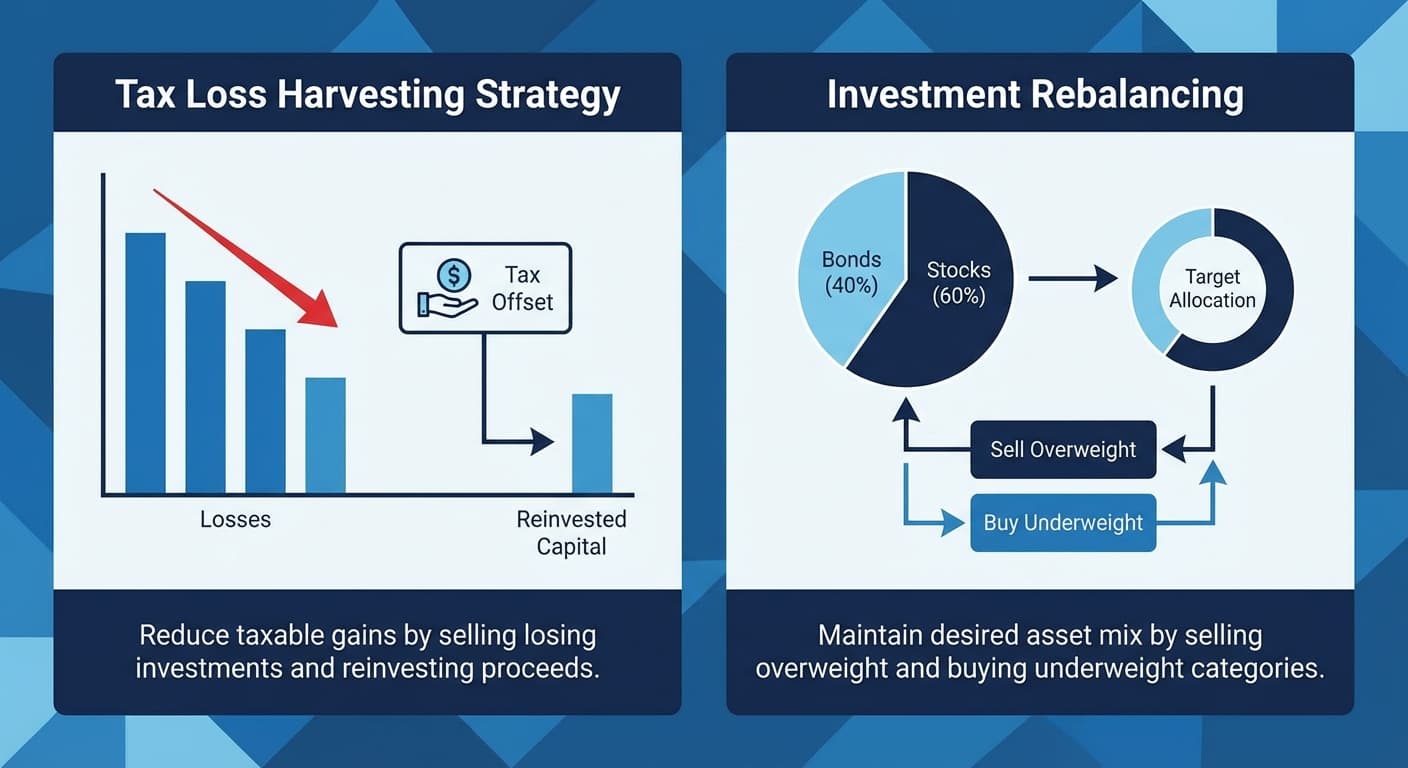
Tax loss harvesting involves selling investments at a loss to offset capital gains from profitable sales. If losses exceed gains, you can deduct up to $3,000 against ordinary income. Excess losses carry forward indefinitely to future tax years.
This strategy works only in taxable investment accounts, not tax-advantaged retirement accounts like 401(k)s or IRAs where gains and losses don't affect current taxes. The IRS allows this legal tax reduction method when executed properly.
How Tax Loss Harvesting Works
Step 1: Identify Losing Positions
Review your taxable investment portfolio for securities trading below purchase price. Compare cost basis to current market value. Stocks, bonds, ETFs, and mutual funds all qualify for tax loss harvesting.
Step 2: Calculate Potential Tax Benefit
Determine total realized capital gains for the year from other sales. Losses offset short-term gains (taxed as ordinary income up to 37%) and long-term gains (taxed at 0%, 15%, or 20%). Short-term losses provide greater tax savings by offsetting higher-taxed gains first.
Step 3: Execute the Sale
Sell the losing investment before December 31st to claim the loss on the current year's tax return. The trade must settle by year-end, which typically takes two business days for stocks (T+2 settlement).
Step 4: Reinvest Strategically
Immediately reinvest proceeds into similar but not substantially identical securities to maintain market exposure. For example, if you sell an S&P 500 index fund, purchase a total market index fund instead. Wait 31 days before repurchasing the original investment to avoid wash sale rules.
Understanding the Wash Sale Rule
The IRS disallows tax loss deductions if you repurchase the same or substantially identical security within 30 days before or after the sale (61-day window total). This prevents taxpayers from claiming artificial losses while maintaining identical positions.
Wash sales don't erase losses permanently. The disallowed loss gets added to the cost basis of the repurchased security, deferring the tax benefit until final sale. However, timing restrictions make immediate tax savings unavailable.
What Triggers Wash Sales
- Repurchasing the exact same stock or fund within 30 days
- Buying substantially identical securities (same company stock, identical ETF)
- Purchasing call options on the sold security
- Spouse, IRA, or controlled corporation purchases the same security
- Acquiring the security through automatic dividend reinvestment
Avoiding Wash Sales
Wait 31 days before repurchasing the sold security. Alternatively, purchase a similar but different investment immediately. For example, sell Vanguard S&P 500 ETF (VOO) and buy iShares Core S&P 500 ETF (IVV). Both track the same index but are not substantially identical under IRS rules.
Tax Loss Harvesting Strategies
Strategy 1: Offset High-Taxed Gains First
Prioritize offsetting short-term capital gains taxed at ordinary income rates up to 37%. Long-term capital gains receive preferential rates of 0%, 15%, or 20%. Harvesting losses to offset short-term gains maximizes tax savings.
Strategy 2: Create Loss Carryforwards
If you lack capital gains this year, harvest losses anyway to create carryforwards. Excess losses deduct $3,000 from ordinary income annually and carry forward indefinitely. Future years with large gains benefit from accumulated loss carryforwards.
Strategy 3: Rebalance While Harvesting
Combine tax loss harvesting with portfolio rebalancing. Sell overweighted losing positions and reinvest in underweighted asset classes. This maintains desired allocation while capturing tax benefits.
Strategy 4: Pair Gains with Losses
Before selling appreciated investments for rebalancing or expenses, harvest offsetting losses. Pairing gains with losses within the same tax year eliminates or reduces capital gains tax liability.
Timing Considerations
December sees heavy tax loss harvesting activity, sometimes creating temporary price depression in losing stocks. Consider harvesting earlier in the year to avoid year-end market dynamics and ensure settlement by December 31st.
Monitor your portfolio quarterly for loss harvesting opportunities rather than waiting until year-end. Market volatility throughout the year provides multiple chances to capture losses and immediately reinvest at similar prices.
Tax Loss Harvesting Example
Sarah sold stocks for a $15,000 long-term capital gain earlier this year. In November, she reviews her portfolio and finds $10,000 in unrealized losses on a technology ETF. She sells the ETF, realizing the $10,000 loss, and immediately purchases a similar but different tech ETF.
Result: Sarah offsets $10,000 of her $15,000 gain, reducing taxable capital gains to $5,000. At a 15% long-term capital gains rate, she saves $1,500 in federal taxes ($10,000 × 15%). She maintains tech sector exposure with the replacement ETF.
Common Mistakes to Avoid
- Triggering wash sales by repurchasing too quickly
- Forgetting about spouse or IRA purchases of the same security
- Missing the December 31st deadline due to settlement delays
- Selling investments with long-term growth potential for minor tax savings
- Failing to track cost basis accurately across multiple purchases
- Ignoring state tax benefits of loss harvesting
- Letting tax strategy override sound investment decisions
Who Benefits Most from Tax Loss Harvesting?
High-income investors in top tax brackets gain the most value from tax loss harvesting. Those facing 37% ordinary income tax rates or 20% long-term capital gains rates see larger absolute tax savings per dollar of harvested loss.
Investors with significant taxable investment accounts benefit more than those primarily holding retirement accounts. Tax loss harvesting doesn't apply to tax-deferred or tax-free accounts where gains and losses have no immediate tax impact.
Conclusion
Tax loss harvesting transforms investment losses into valuable tax deductions. When executed properly with attention to wash sale rules and strategic timing, this technique reduces tax liability while maintaining investment exposure. Start reviewing your portfolio now for loss harvesting opportunities before year-end.
Use our Capital Gains Tax Calculator to estimate tax savings from loss harvesting strategies and optimize your year-end investment decisions.
Frequently Asked Questions
What is the wash sale rule?
The wash sale rule disallows tax loss deductions if you repurchase the same or substantially identical security within 30 days before or after the sale (61-day window total). The loss isn't eliminated—it's added to the cost basis of the repurchased security, deferring the tax benefit.
Can I sell a stock at a loss and immediately buy a similar one?
Yes, as long as it's not substantially identical. For example, you can sell Vanguard S&P 500 ETF (VOO) and immediately buy iShares Core S&P 500 ETF (IVV). Both track the same index but are different securities, so wash sale rules don't apply.
Does tax loss harvesting work in retirement accounts?
No. Tax loss harvesting only works in taxable investment accounts. Gains and losses in IRAs, 401(k)s, and other tax-advantaged accounts have no immediate tax impact, so harvesting losses provides no benefit.
How much can I deduct from tax loss harvesting?
Losses first offset capital gains dollar-for-dollar. If losses exceed gains, you can deduct up to $3,000 against ordinary income annually. Excess losses carry forward indefinitely to future tax years, where the same rules apply.
When is the deadline for tax loss harvesting?
Trades must settle by December 31st to count for the current tax year. Since stocks settle T+2 (two business days), execute sales by December 27th in most years. Plan earlier if holidays affect settlement schedules.