
Social Security Tax Guide 2026
Published on May 2026
Most Americans pay $10,000+ in Social Security tax annually—but many overpay and don't even know it. Workers with multiple jobs often have excess FICA withholding (refundable on tax return), while self-employed individuals miss the 50% deduction that reduces their tax bill by thousands.
The problem? Social Security tax has a wage base cap ($168,600 for 2026) that creates opportunities and pitfalls. Employees making $300K at one job stop paying Social Security tax mid-year, but those earning $150K each at two jobs overpay by $3,000+ (refundable only after filing). Self-employed workers often forget to deduct half their SE tax, losing $5,000+ in deductions.
This guide explains exactly how Social Security tax works in 2026—and how to avoid overpaying. We break down FICA rates (6.2% + 6.2% = 12.4%), the $168,600 wage base cap, self-employment tax calculations (Schedule SE), multiple-job overpayment refunds, and the 40-credit requirement for retirement benefits.
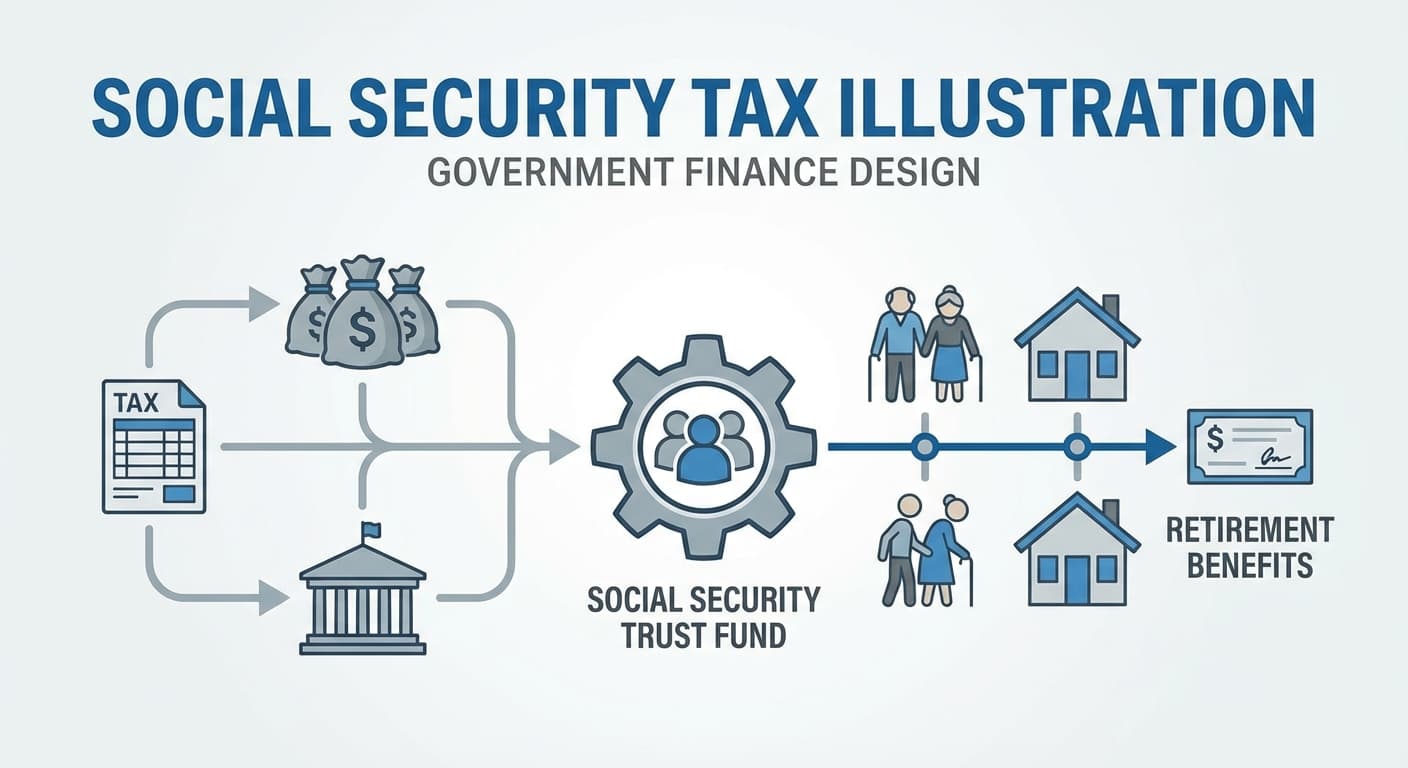
Social Security tax finances retirement, disability, and survivor benefits through payroll taxes. Understanding the wage base limit, tax rates, and self-employment obligations ensures proper planning and benefits accumulation.
FICA Tax Rates
Employees pay 6.2% on wages up to $168,600 in 2026 with employers matching. Self-employed individuals pay both portions (12.4%) but deduct half as a business expense, reducing net cost.
Wage Base Limit
Social Security tax applies only to first $168,600 of wages in 2026. Income above this limit faces no additional Social Security tax, unlike Medicare tax which has no cap.
Self-Employment Calculations
Calculate self-employment tax on Schedule SE. Multiply net self-employment income by 92.35%, then apply 12.4% Social Security tax plus 2.9% Medicare tax. Deduct half of self-employment tax on Form 1040.
Multiple Jobs
If working multiple jobs, each employer withholds Social Security tax up to wage base. Excess withholding above $10,453 can be claimed as refundable credit on tax return.
Benefits Eligibility
Accumulate 40 credits (10 years of work) to qualify for retirement benefits. Higher lifetime earnings increase monthly benefit amounts. Delaying benefits past full retirement age increases monthly payments.
Frequently Asked Questions
What is the Social Security tax rate for 2026?
Employees pay 6.2% on wages up to $168,600 in 2026, with employers matching for total 12.4%. Self-employed individuals pay both portions (12.4%) but deduct half as a business expense. Medicare adds 1.45% each (2.9% total) with no wage cap, plus 0.9% Additional Medicare Tax on high earners.
What is the Social Security wage base limit for 2026?
The wage base limit is $168,600 for 2026. Social Security tax applies only to the first $168,600 of wages. Income above this limit faces no additional Social Security tax, though Medicare tax continues on all wages. Maximum employee contribution: $10,453.20 ($168,600 × 6.2%).
How do I calculate self-employment tax?
Calculate on Schedule SE: (1) Multiply net self-employment income by 92.35%, (2) Apply 12.4% Social Security tax on first $168,600 and 2.9% Medicare tax on all income, (3) Total is your self-employment tax. Deduct half of self-employment tax on Form 1040 as an adjustment to income, reducing your AGI.
What happens if I work multiple jobs and exceed the wage base?
Each employer withholds Social Security tax separately up to the wage base, potentially causing over-withholding. If total withholding exceeds $10,453.20 (6.2% × $168,600), claim the excess as a refundable credit on Form 1040. You cannot request reduced withholding during the year—the refund comes when filing your return.
How many credits do I need to qualify for Social Security benefits?
You need 40 credits (10 years of work) to qualify for retirement benefits. Earn up to 4 credits per year by earning $1,730 per credit in 2026 (total $6,920 for 4 credits). Higher lifetime earnings increase your monthly benefit amount calculated on your highest 35 years of indexed earnings.
Can I reduce or avoid Social Security tax?
No legal way to avoid FICA tax on wages or self-employment income. Strategies to manage exposure: Maximize retirement account contributions (reduces income tax, not FICA), incorporate S-corp if self-employed (reasonable salary pays FICA, distributions don't), or time income recognition to spread high earnings across multiple years if near wage base limit.
Does Social Security tax apply to investment income?
No. Social Security tax applies only to wages, salaries, tips, and net self-employment income. Investment income (interest, dividends, capital gains, rental income) is not subject to FICA tax. However, high earners pay 3.8% Net Investment Income Tax on investment income, which is separate from and in addition to regular income tax.
How does Social Security tax differ from Medicare tax?
Key differences: Social Security has wage base cap ($168,600 for 2026), Medicare has no cap. Social Security rate: 6.2% employee + 6.2% employer (12.4% self-employed). Medicare rate: 1.45% + 1.45% (2.9% self-employed), plus 0.9% Additional Medicare Tax on wages over $200,000 single/$250,000 married. Both fund different programs—Social Security for retirement/disability, Medicare for healthcare.
Conclusion
Social Security tax funds crucial retirement benefits while creating current payroll tax obligations. Understand wage base limits, claim excess withholding refunds when working multiple jobs, and plan self-employment income to manage total FICA exposure.
Use our Tax Calculator to estimate your tax liability and optimize your tax strategy for 2026.