
Quarterly Tax Payments: A Complete Guide
Published on January 2026
If you're self-employed, a freelancer, or have significant investment income, you're likely required to make quarterly estimated tax payments. Understanding this system is essential to avoid penalties and manage your cash flow effectively throughout the year.
Who Must Make Quarterly Payments?
You must make quarterly estimated tax payments if you expect to owe at least $1,000 in taxes after subtracting withholding and credits. This typically applies to self-employed individuals, freelancers, independent contractors, and investors with substantial capital gains or dividend income.
Even some employees may need to make quarterly payments if they have side income or their withholding is insufficient. If you had a tax liability last year and expect similar or higher income this year, you likely need to make estimated payments.
When Are Quarterly Payments Due?
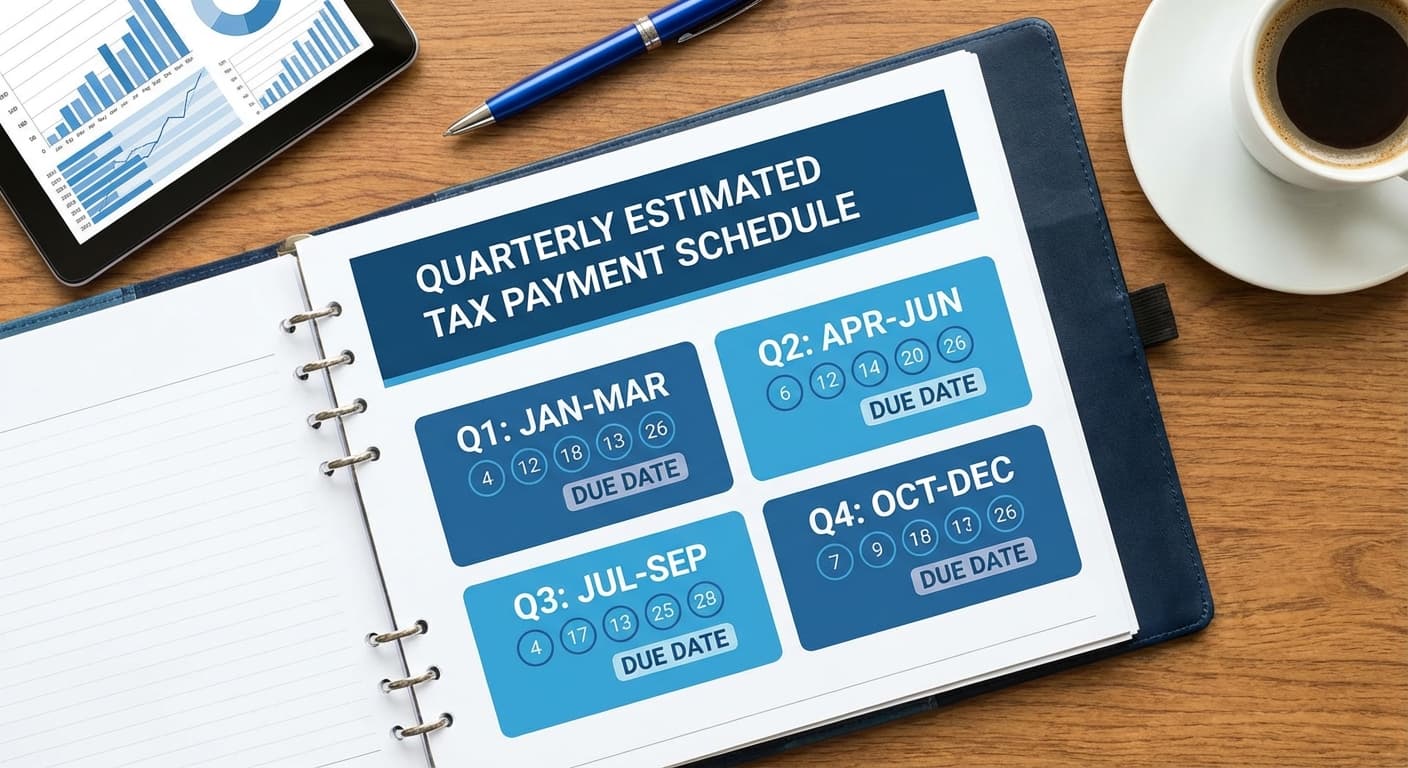
Despite the name "quarterly," the payment periods aren't exactly three months apart. For 2026, the due dates are:
First Quarter: April 15, 2026 (covers January 1 - March 31)
Second Quarter: June 17, 2026 (covers April 1 - May 31)
Third Quarter: September 16, 2026 (covers June 1 - August 31)
Fourth Quarter: January 15, 2026 (covers September 1 - December 31)
If a due date falls on a weekend or holiday, the deadline moves to the next business day. Mark these dates on your calendar and set reminders to avoid missing payments and incurring penalties.
How to Calculate Your Quarterly Payment
Calculate your estimated payments using Form 1040-ES. The IRS provides two safe harbor methods to avoid underpayment penalties: pay 90% of your current year's expected tax liability, or pay 100% of last year's total tax (110% if your adjusted gross income exceeded $150,000).
Most taxpayers use the prior-year method because it's simpler and provides certainty. Take last year's total tax from line 24 of Form 1040, divide by four, and pay that amount each quarter. If your income varies significantly, you may want to calculate each quarter based on actual income.
Methods for Making Payments
The IRS offers several convenient ways to pay estimated taxes. The easiest method is through IRS Direct Pay on their website, which is free and allows you to pay directly from your bank account. You can also use the Electronic Federal Tax Payment System (EFTPS) for scheduled payments.
Other options include paying by credit or debit card (with a processing fee), mailing a check with Form 1040-ES, or using the IRS2Go mobile app. Electronic payment methods provide instant confirmation and are generally more reliable than mailing checks.
Avoiding Underpayment Penalties
The IRS charges interest and penalties if you don't pay enough tax throughout the year. The penalty rate varies but is typically around 8% annually, applied to the amount you underpaid for the period it was underpaid.
You can avoid penalties by meeting one of the safe harbor rules or by showing that your income was uneven throughout the year using the annualized income installment method. This method is more complex but can help if your income is seasonal or irregular.
Tips for Managing Quarterly Payments
Set aside 25-30% of each payment you receive in a separate savings account dedicated to taxes. This ensures you'll have funds available when quarterly payments are due and prevents cash flow problems.
Consider making your payments slightly higher than required if you expect income growth. It's better to overpay slightly and receive a refund than to underpay and face penalties. You can also adjust your payments mid-year if your income changes significantly.
Conclusion
Making quarterly estimated tax payments is a crucial responsibility for self-employed individuals and those with non-wage income. By understanding the due dates, calculation methods, and payment options, you can stay compliant and avoid costly penalties.
Calculate your quarterly payment amounts with our Tax Estimator to stay on track throughout the year.