
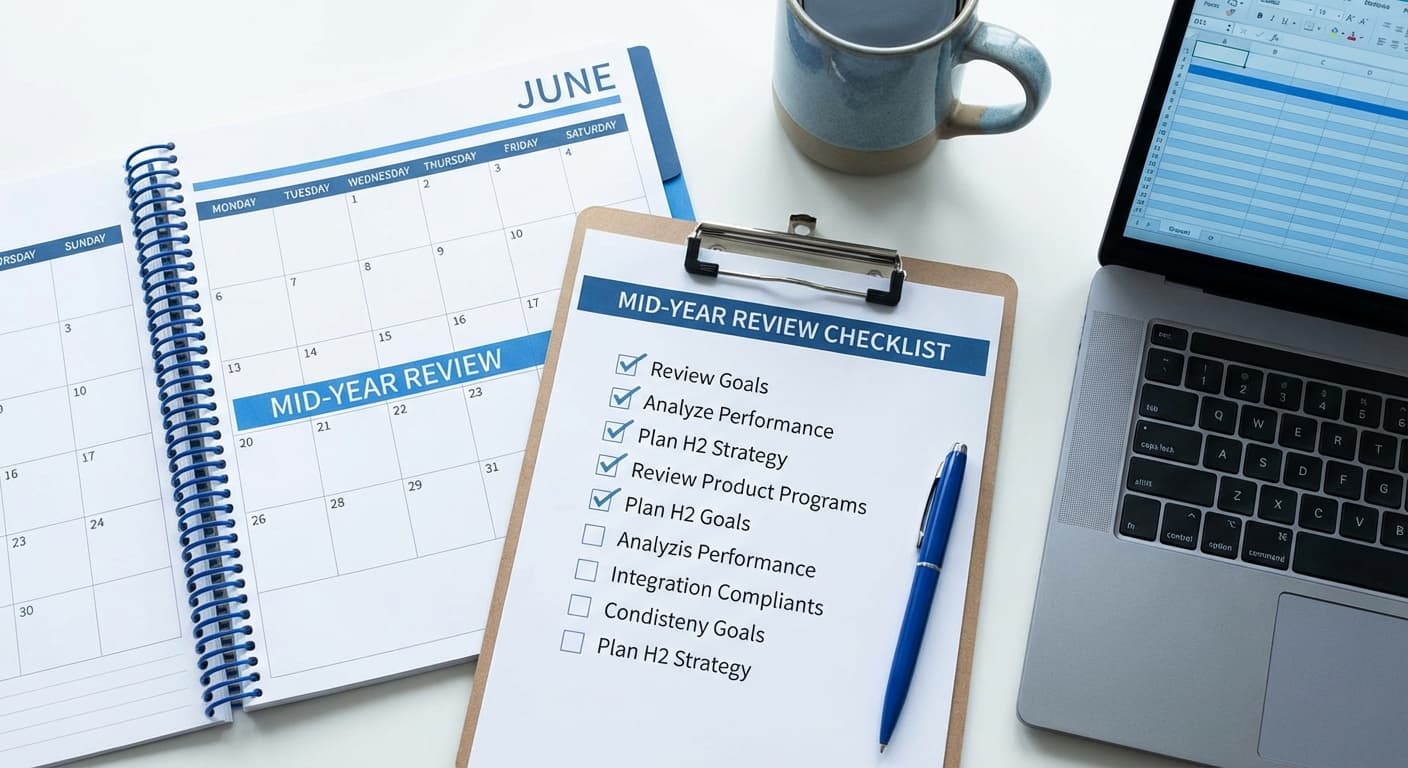
Mid-Year Tax Review Checklist 2026
Published on June 2026
April arrives, you file your taxes, and... surprise! You owe $4,000. Or worse, you gave the IRS an interest-free $6,000 loan all year through excessive withholding.
The problem? Life doesn't follow the IRS withholding assumptions. New jobs, marriages, side hustles, bonuses, investment gains—all change your tax situation mid-year. But most people never adjust their W-4, leading to underpayment penalties or massive refunds that could've been earning interest in your account.
This mid-year tax checklist shows you exactly what to review in June or July. Learn how to check withholding accuracy, when to file a new W-4, retirement contribution optimization, estimated tax payment safe harbors, deduction bunching strategies, and year-end moves that reduce your 2026 tax bill by thousands.
Waiting until tax season to review your financial situation often leads to missed opportunities and unexpected tax bills. A mid-year tax check-up in June or July gives you time to adjust strategies and maximize savings before December 31st.
Why Review Taxes Mid-Year?
Life changes throughout the year affect your tax situation: new jobs, marriages, children, home purchases, or investment gains. The IRS withholding calculator and quarterly estimated tax system assume steady income, which rarely matches reality.
Mid-year reviews prevent underpayment penalties and allow proactive adjustments. According to the IRS, over 30% of taxpayers either owe money or receive excessive refunds due to incorrect withholding, tying up cash unnecessarily.
Income Changes Checklist
Review All Income Sources
- Compare year-to-date income against annual projections
- Account for bonuses, commissions, or irregular payments received
- Track freelance or side hustle income not subject to withholding
- Review investment dividends and capital gains distributions
- Note any unemployment benefits or severance packages
Adjust Withholding if Needed
If income increased significantly, you may be underwithholding. Use the IRS Tax Withholding Estimator to calculate correct withholding amounts. Submit a new W-4 form to your employer to increase withholding for the remainder of the year.
Conversely, if you're on track for a large refund (over $3,000), you're giving the government an interest-free loan. Reduce withholding to increase take-home pay and invest the difference.
Deduction Optimization Review
Standard vs Itemized Decision
Calculate your year-to-date itemizable expenses: mortgage interest, state and local taxes (capped at $10,000), charitable donations, and medical expenses exceeding 7.5% of AGI. Compare against the standard deduction ($14,600 single, $29,200 married filing jointly for 2026).
If you're close to the threshold, consider bunching deductions. Make two years of charitable contributions in one year or prepay January property taxes in December to exceed the standard deduction.
Business Expense Tracking
For self-employed individuals, review business expense documentation. Ensure proper categorization of home office costs, vehicle mileage, supplies, insurance, and professional fees. Missing receipts now is easier to fix than during tax season.
Retirement Contribution Check
Review 401(k), 403(b), or TSP contributions against annual limits ($23,000 for 2026, $30,500 if 50+). Calculate if you're on pace to maximize contributions by year-end. Increasing contributions now reduces taxable income and accelerates retirement savings.
Self-employed individuals should estimate net earnings to determine maximum SEP-IRA or Solo 401(k) contributions. Consider whether traditional pre-tax or Roth after-tax contributions make more sense based on current versus expected future tax rates.
Life Changes Impact Assessment
Marriage or Divorce
Your filing status is determined by your marital status on December 31st. Married couples should compare filing jointly versus separately to optimize tax liability. Divorce settlements may include taxable alimony or tax-free property transfers.
New Dependents
Children born or adopted this year qualify for the Child Tax Credit ($2,000 per child) and potentially the Child and Dependent Care Credit. Update W-4 forms to reflect additional dependents and reduce withholding accordingly.
Home Purchase
First-time homebuyers gain significant tax benefits: mortgage interest deduction on loans up to $750,000 and property tax deductions (subject to $10,000 cap). Itemizing becomes more likely, potentially saving thousands compared to the standard deduction.
Investment Portfolio Review
Evaluate unrealized gains and losses in taxable investment accounts. If you have substantial gains, identify losing positions for potential tax-loss harvesting later in the year. Balance capital gains with losses to minimize tax liability.
Review dividend and interest income. High earners may owe Net Investment Income Tax (3.8% surtax on investment income when MAGI exceeds $200,000 single or $250,000 married). Plan accordingly for year-end estimated tax payments.
Estimated Tax Payment Review
Self-employed individuals and those with significant non-wage income must make quarterly estimated tax payments. Review payments made in April and June against projected annual tax liability.
Safe harbor rules require paying 90% of current year tax or 100% of prior year tax (110% if AGI exceeds $150,000). If you're falling short, increase September and January payments to avoid underpayment penalties.
Healthcare Considerations
Review Health Savings Account contributions if you have a high-deductible health plan. The 2026 limit is $4,150 for individuals and $8,300 for families (plus $1,000 catch-up if 55+). HSA contributions reduce taxable income and grow tax-free.
Check Flexible Spending Account balances and planned medical expenses. Most FSAs have "use it or lose it" rules, so verify your employer's carryover or grace period policies.
Action Items for the Second Half
- Update W-4 withholding forms based on mid-year income projections
- Increase retirement contributions to reach annual limits
- Organize deductible expense receipts and documentation
- Schedule tax-loss harvesting opportunities in investment accounts
- Make September estimated tax payment on time (September 15th)
- Max out HSA contributions for triple tax savings
- Review charitable giving strategy for potential bunching
Frequently Asked Questions
Why should I do a mid-year tax review?
Mid-year tax reviews prevent underpayment penalties, catch withholding errors early, and give you 6 months to optimize strategies. Life changes (new jobs, marriages, children, home purchases) affect taxes throughout the year. Reviewing in June/July lets you adjust withholding, maximize deductions, and avoid year-end surprises.
How do I know if my withholding is correct?
Use the IRS Tax Withholding Estimator with year-to-date income and withholding info from paystubs. If you're on track to owe more than $1,000 or receive a refund over $3,000, adjust withholding via Form W-4. Dual-income couples, freelancers, and those with investment income commonly need adjustments.
When should I adjust my W-4 form?
Adjust your W-4 after major life events: marriage/divorce, new dependents, job changes, significant income increases, large bonuses, or home purchases. Mid-year is ideal because changes made in July apply to the remaining 6 months of paychecks, allowing time to correct underwithholding or reduce excessive refunds.
What are safe harbor rules for estimated taxes?
Avoid underpayment penalties by paying either: 1) 90% of current year's tax, or 2) 100% of prior year's tax (110% if AGI exceeds $150,000). Self-employed individuals and those with non-wage income must make quarterly payments (April 15, June 15, September 15, January 15) to meet safe harbor requirements.
Should I itemize deductions or take the standard deduction?
Calculate mid-year itemizable expenses (mortgage interest, state/local taxes up to $10,000, charitable donations, medical expenses over 7.5% AGI). Compare against standard deduction ($14,600 single, $29,200 married joint for 2026). If you're close, consider 'bunching' deductions—making two years of charitable contributions in one year to exceed the standard deduction.
How can I reduce my tax bill before year-end?
Strategies include: 1) Max out 401(k) contributions ($23,000 limit, $30,500 if 50+), 2) Contribute to HSA if eligible ($4,150 single, $8,300 family), 3) Tax-loss harvesting in taxable investment accounts, 4) Bunch itemizable deductions into one year, 5) Defer income to next year if possible, and 6) Accelerate deductible expenses into current year.
Conclusion
A comprehensive mid-year tax review takes two to three hours but can save thousands in taxes and prevent year-end scrambling. Address issues now while you have six months to implement changes. Regular reviews create better financial outcomes than reactive tax season stress.
Use our Tax Calculator to project your year-end tax liability and test different scenarios. Adjust your strategy based on the results to optimize your tax position before December 31st.