
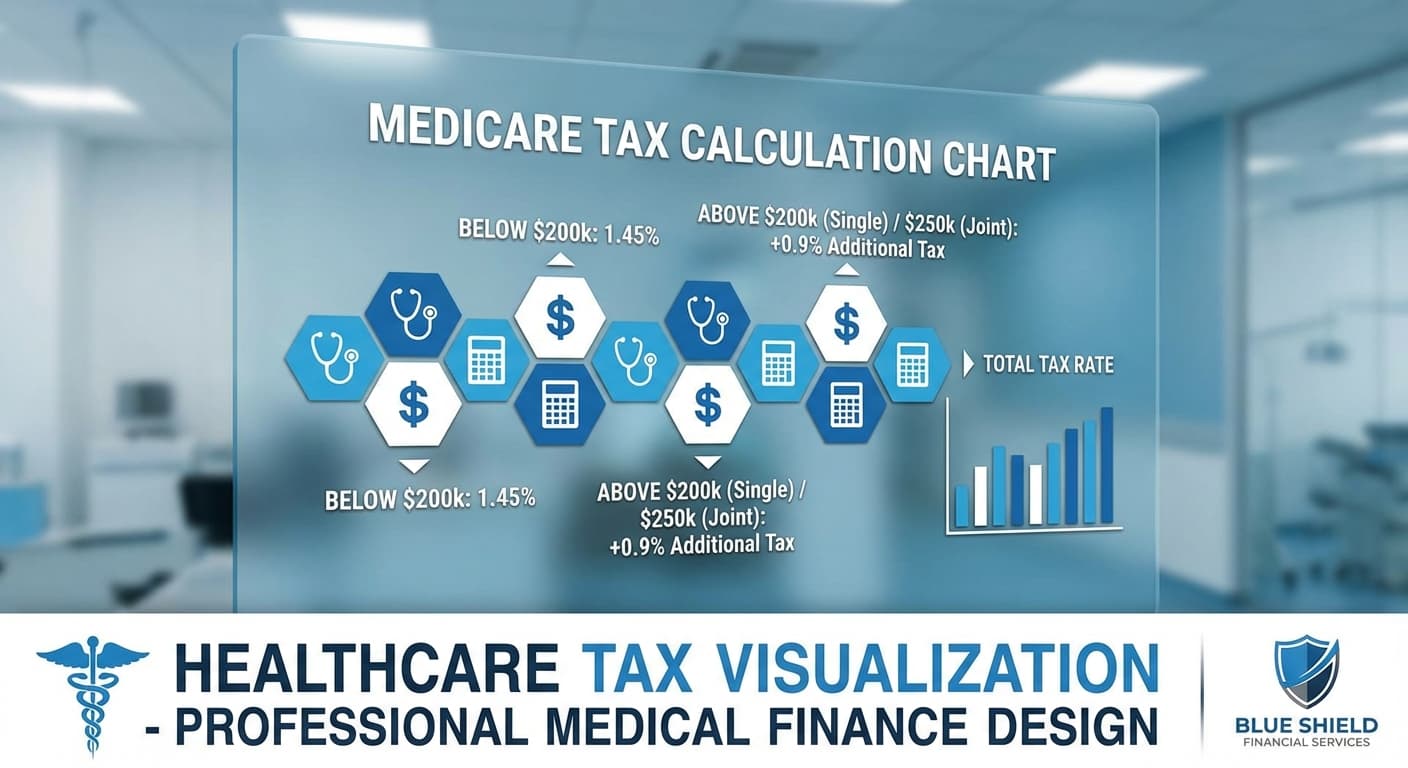
Medicare Tax Calculation 2026
Published on April 2026
Your paycheck stub shows "Medicare Tax" at 1.45%—but if you earn over $200,000, you're actually paying 2.35%. Many high earners discover this surprise only when they owe thousands at tax time because employer withholding didn't cover the Additional Medicare Tax.
The problem? Medicare tax has no income cap (unlike Social Security), and the 0.9% Additional Medicare Tax kicks in at different thresholds depending on filing status. Employers withhold based on individual wages, not household income, creating underwithholding for dual-income couples. Self-employed individuals must calculate and pay both portions themselves.
This guide explains every Medicare tax rule for 2026. Learn standard rates (1.45% employee, 1.45% employer), Additional Medicare Tax thresholds ($200K single, $250K married), self-employment calculations (2.9% + 0.9%), withholding strategies for dual-income couples, and how Net Investment Income Tax differs from Medicare tax.
Medicare tax funds healthcare for seniors through payroll taxes. While most workers pay 1.45% on wages, high earners face Additional Medicare Tax of 0.9% above income thresholds, requiring careful tax planning and withholding.
Standard Medicare Tax
Employees pay 1.45% of wages with employer matching another 1.45% (2.9% total). No income cap applies unlike Social Security tax. All wages face Medicare tax regardless of amount earned.
Additional Medicare Tax
Income above $200,000 (single) or $250,000 (married filing jointly) triggers additional 0.9% Medicare tax. This applies to wages, self-employment income, and Railroad Retirement Tax Act compensation combined.
Self-Employment Medicare
Self-employed individuals pay both employee and employer portions (2.9% total). Income over thresholds faces additional 0.9%, totaling 3.8% Medicare tax on self-employment earnings above limits.
Withholding Requirements
Employers withhold Additional Medicare Tax on wages over $200,000 regardless of filing status. This may underwithhold for married couples where both spouses earn under $200,000 individually but exceed $250,000 combined.
Planning Strategies
Request additional withholding via Form W-4 if combined income triggers Additional Medicare Tax. Make estimated payments to avoid underpayment penalties. Consider timing bonuses or income to manage thresholds.
Frequently Asked Questions
What is the Medicare tax rate for 2026?
The standard Medicare tax rate is 2.9% total: employees pay 1.45% and employers match 1.45%. Self-employed individuals pay the full 2.9%. There is no income cap—Medicare tax applies to all wages and self-employment income regardless of amount.
What is Additional Medicare Tax and when does it apply?
Additional Medicare Tax is an extra 0.9% tax on income above $200,000 (single), $250,000 (married filing jointly), or $125,000 (married filing separately). It applies to wages, self-employment income, and Railroad Retirement Tax Act compensation combined. This brings total Medicare tax to 2.35% for employees or 3.8% for self-employed on amounts above thresholds.
Do employers automatically withhold Additional Medicare Tax?
Employers withhold Additional Medicare Tax on wages exceeding $200,000 regardless of filing status. This creates underwithholding for married couples where both spouses earn under $200,000 individually but exceed $250,000 combined. Request additional withholding via Form W-4 to avoid underpayment penalties.
How do self-employed individuals pay Medicare tax?
Self-employed individuals pay 2.9% Medicare tax on net self-employment income (both employee and employer portions). Income above thresholds ($200,000 single, $250,000 married joint) faces an additional 0.9%, totaling 3.8% Medicare tax. Pay through quarterly estimated taxes using Form 1040-ES.
Is there an income cap on Medicare tax like Social Security?
No. Unlike Social Security tax (capped at $168,600 in 2026), Medicare tax applies to ALL earned income with no upper limit. Whether you earn $50,000 or $5 million, every dollar faces Medicare tax.
What is the Net Investment Income Tax (NIIT)?
NIIT is a separate 3.8% tax on investment income (interest, dividends, capital gains, rental income) for high earners. It applies when modified adjusted gross income exceeds $200,000 (single) or $250,000 (married joint). While often confused with Medicare tax, NIIT funds general revenue, not Medicare, and applies only to passive investment income, not earned income.
Conclusion
Understanding Medicare tax rates and Additional Medicare Tax thresholds prevents underpayment surprises. Monitor combined income approaching thresholds, adjust withholding proactively, and coordinate between spouses to optimize total Medicare tax liability.
Use our Tax Calculator to estimate your tax liability and optimize your tax strategy for 2026.