
2025 Tax Year Estimated Payments (Due in 2026)
Published on January 2026 | For 2025 Tax Year
Hit with a $5,000 underpayment penalty and interest charges because you didn't know about quarterly estimated tax payments? You're among thousands of self-employed workers and investors who learn about this requirement the hard way—after the IRS sends a bill with penalties.
The problem is that if you don't have taxes withheld from paychecks, you must pay the IRS quarterly—not just at year-end. Miss a payment or underpay by too much, and you face penalties of 3-5% annually on the shortfall. The deadlines are irregular (April, June, September, January), calculations are complex, and the IRS provides little guidance until it's too late.
This comprehensive guide explains exactly how estimated tax payments work for 2026. You'll learn who must pay, the precise quarterly deadlines, safe harbor rules that eliminate penalty risk, calculation methods for uneven income, payment options, Form 1040-ES instructions, and strategies to adjust mid-year when income changes unexpectedly.
Self-employed individuals, freelancers, and investors must make quarterly estimated tax payments to avoid penalties. Understanding deadlines, calculation methods, and safe harbor rules ensures compliance and prevents costly interest charges.
Who Must Make Estimated Tax Payments?
You must make estimated tax payments if you expect to owe $1,000 or more when filing your tax return. This typically applies to self-employed individuals, independent contractors, small business owners, landlords, and investors with significant dividend or capital gains income.
W-2 employees with substantial side income, multiple jobs, or investment gains may also need to make estimated payments if employer withholding doesn't cover total tax liability. The IRS pay-as-you-go system requires tax payments throughout the year, not just at filing.
2026 Estimated Tax Payment Deadlines
Quarterly Payment Due Dates
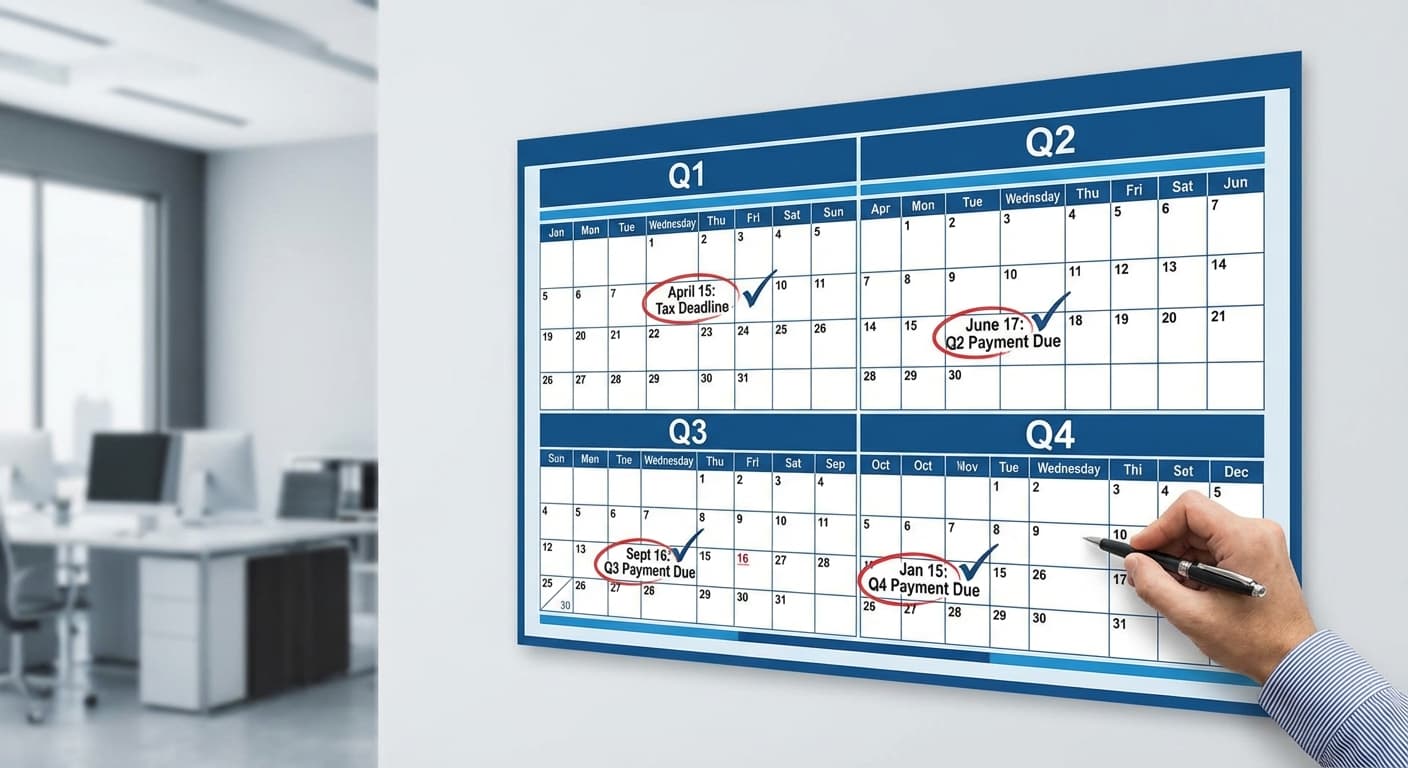
- Q1 Payment: April 15, 2026 (covers January 1 - March 31)
- Q2 Payment: June 17, 2026 (covers April 1 - May 31)
- Q3 Payment: September 16, 2026 (covers June 1 - August 31)
- Q4 Payment: January 15, 2026 (covers September 1 - December 31)
Note that quarterly periods are not equal length. The second quarter covers only two months while the third quarter covers three months. If a deadline falls on a weekend or federal holiday, the due date moves to the next business day.
How to Calculate Estimated Tax Payments
Method 1: Prior Year Safe Harbor
The simplest method pays 100% of last year's total tax liability divided into four equal payments. If your AGI exceeded $150,000 ($75,000 if married filing separately), you must pay 110% of prior year tax. This safe harbor protects against penalties regardless of current year income.
Example: If your 2023 total tax was $20,000 and AGI was under $150,000, pay $5,000 each quarter in 2026. Even if you earn more in 2026, you won't face underpayment penalties using this method.
Method 2: Current Year Estimate
Project your 2026 income, deductions, and credits to estimate total tax liability. Pay 90% of your estimated 2026 tax in quarterly installments. This method works well if income will decrease significantly from the prior year.
Use Form 1040-ES worksheets to calculate estimated tax. Include self-employment tax (15.3% on net earnings up to $168,600, then 2.9% on amounts above), income tax based on brackets, and any additional taxes like Net Investment Income Tax.
Method 3: Annualized Income Method
If income varies significantly throughout the year (seasonal business, large Q4 bonus), calculate tax owed based on actual income earned through each quarter. This prevents overpaying early in the year when income is lower.
Payment Methods
IRS Direct Pay (Free)
Pay directly from your checking or savings account through IRS.gov. No registration required, immediate confirmation, and ability to schedule payments up to 365 days in advance. This is the simplest and fastest payment method.
Electronic Federal Tax Payment System (EFTPS)
Free enrollment-based system allowing scheduled payments and payment history tracking. After enrollment (takes 5-7 business days), schedule payments up to a year in advance. Ideal for regular quarterly payers.
Credit or Debit Card
Pay through IRS-approved payment processors with convenience fees ranging from 1.85% to 1.99% of payment amount. Fees are not deductible. Only use this method if earning credit card rewards exceeding fees.
Mail Payment
Send check or money order with Form 1040-ES payment voucher to the IRS address for your state. Allow 7-10 days for mail delivery. Use certified mail for large payments to verify IRS receipt.
Safe Harbor Rules
Meeting safe harbor requirements eliminates underpayment penalties even if you owe additional tax when filing. You satisfy safe harbor by paying the lesser of 90% of current year tax or 100% of prior year tax (110% if high income).
Another safe harbor: if you owe less than $1,000 after subtracting withholding and credits, no penalty applies. W-2 employees can avoid estimated payments by increasing withholding to cover additional income tax.
Underpayment Penalties
The IRS charges interest on late or insufficient estimated tax payments. The current underpayment penalty rate is the federal short-term rate plus 3 percentage points, compounded daily. Penalties accumulate from the quarterly due date until payment.
Form 2210 calculates underpayment penalties when filing your tax return. The IRS may waive penalties for reasonable cause such as casualty, disaster, or unusual circumstances beyond your control. However, intentional underpayment or lack of planning doesn't qualify for waivers.
Special Situations
First Year Self-Employment
If you start self-employment mid-year, you may not owe estimated taxes for the full year. Calculate expected net earnings and self-employment tax. If you had $0 tax liability last year, the prior year safe harbor doesn't help, use the 90% current year method instead.
Variable Income
Freelancers and seasonal businesses can use the annualized income installment method to match payments with income timing. Pay more in high-income quarters and less in slow quarters. This requires more complex calculations but avoids tying up cash when income is low.
Increased W-4 Withholding Instead
W-2 employees with side income can increase paycheck withholding instead of making estimated payments. Submit a new W-4 requesting additional withholding per paycheck. The IRS treats withholding as paid evenly throughout the year, helping avoid underpayment penalties.
Tips for Managing Estimated Taxes
- Set aside 25-30% of self-employment income for taxes in a separate savings account
- Schedule automatic quarterly payments through EFTPS to never miss deadlines
- Review income quarterly and adjust remaining payments if income changes significantly
- Keep detailed records of income and expenses to accurately calculate net earnings
- Consider paying slightly more than required to avoid underpayment surprises
- File Form 4868 extension if you need more time, but pay estimated tax by April 15
State Estimated Taxes
Most states with income taxes require estimated tax payments on the same quarterly schedule as federal. State safe harbor rules and thresholds vary. Check your state tax authority website for specific requirements, deadlines, and payment options.
Some states accept federal estimated tax calculations as starting points. Others require separate state-specific calculations. High-tax states like California, New York, and New Jersey have significant estimated payment requirements.
Frequently Asked Questions
Q: Who needs to make estimated tax payments?
You must make estimated tax payments if you expect to owe $1,000 or more when filing. This includes self-employed individuals, freelancers, contractors, business owners, landlords, and investors with significant investment income. W-2 employees with substantial side income also may need to pay estimated taxes.
Q: When are quarterly estimated tax payments due in 2026?
Q1 (Jan-Mar income): April 15, 2026; Q2 (Apr-May income): June 16, 2026; Q3 (Jun-Aug income): September 15, 2026; Q4 (Sep-Dec income): January 15, 2027. If a deadline falls on a weekend or holiday, payment is due the next business day.
Q: What is the safe harbor rule for estimated taxes?
You avoid underpayment penalties if you pay either 90% of current year tax or 100% of prior year tax (110% if AGI exceeds $150,000). This safe harbor protects you even if your income increases significantly. Most people use 100%/110% of prior year as it's predictable.
Q: How do I calculate quarterly estimated tax payments?
Estimate your total annual income, deductions, and credits. Calculate expected tax liability. Subtract withholding and credits. Divide remaining amount by 4 for quarterly payments. Alternatively, use 100%/110% of prior year tax divided by 4 for safe harbor method.
Q: What if I miss an estimated tax payment?
Make the payment as soon as possible. The IRS calculates penalties on a quarterly basis, so you'll owe interest on the late amount. You can't make up for a missed quarter by paying extra in the next quarter—each period stands alone. Penalties are typically 3-5% annually.
Q: Can I adjust my estimated tax payments mid-year?
Yes, adjust payments if income changes significantly. If Q1 income was low, reduce Q2-Q4 payments. If you have a windfall, increase remaining payments. The annualized income method (Form 2210) allows unequal payments matching actual quarterly income patterns.
Q: How do I pay estimated taxes?
Pay online via IRS Direct Pay, EFTPS, or credit card (fees apply). Mail Form 1040-ES with check. Set up automatic EFTPS payments to avoid missing deadlines. Online payments can be scheduled in advance and provide instant confirmation.
Q: Do I need to make all four quarterly payments?
Only if you have income throughout the year. If your taxable income starts mid-year, you only pay for remaining quarters. Make your first payment when you have taxable income, then continue quarterly. If income stops, you can skip remaining payments.
Conclusion
Staying current with estimated tax payments prevents penalties and interest while managing cash flow throughout the year. Mark quarterly deadlines on your calendar, calculate payments using safe harbor rules, and choose convenient payment methods. Proactive estimated tax management eliminates April 15th stress.
Use our Estimated Tax Calculator to determine your quarterly payment amounts and avoid underpayment penalties in 2026.