
Capital Gains Tax Explained Simply
Published on January 2026
Sold stocks for a $40,000 profit and shocked by a $14,800 tax bill? You're not alone—most investors discover capital gains tax the hard way, paying thousands more than necessary because they didn't understand the timing rules.
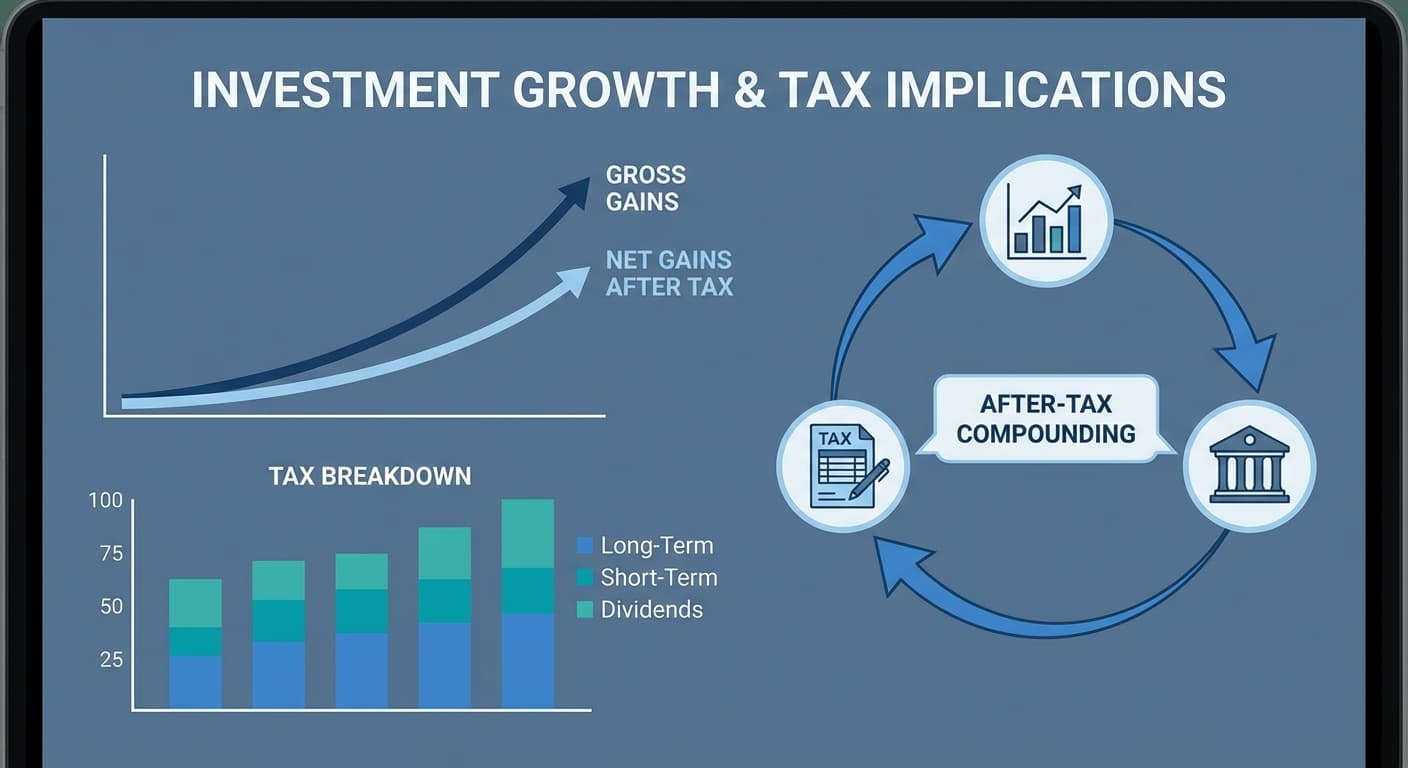
The problem is that capital gains tax can eat 37% of short-term profits (assets held under one year) but only 0-20% for long-term holdings. Sell one day too early, and you could pay double or triple the tax. Add the 3.8% Net Investment Income Tax for high earners, and poor timing costs tens of thousands annually.
This comprehensive guide explains exactly how capital gains tax works in 2026. You'll learn the difference between short-term and long-term rates, how to calculate your basis correctly, tax-loss harvesting strategies that offset gains, special rules for real estate and collectibles, and the precise holding periods that can cut your tax bill in half.
When you sell investments like stocks, bonds, or real estate for more than you paid, you realize a capital gain. Understanding how these gains are taxed can help you make smarter investment decisions and potentially save thousands in taxes.
Short-Term vs. Long-Term Capital Gains
The tax rate on your capital gains depends on how long you held the asset. Short-term capital gains apply to assets held for one year or less and are taxed at your ordinary income tax rate, which can be as high as 37%.
Long-term capital gains apply to assets held for more than one year and receive preferential tax treatment. For 2026, long-term capital gains are taxed at 0%, 15%, or 20% depending on your taxable income. Most taxpayers fall into the 15% bracket.
Single filers with taxable income up to $47,025 pay 0% on long-term gains. Income between $47,026 and $518,900 is taxed at 15%, and income above $518,900 is taxed at 20%. This preferential treatment makes holding investments longer than a year significantly more tax-efficient.
Calculating Your Capital Gain or Loss
Your capital gain or loss is the difference between your basis (what you paid for the asset plus any improvements) and the sale price minus selling expenses. For stocks, your basis is typically the purchase price plus any commissions paid.
If you sell an asset for less than your basis, you have a capital loss. Capital losses can offset capital gains dollar-for-dollar. If your losses exceed your gains, you can deduct up to $3,000 against ordinary income per year and carry forward additional losses to future years.
Tax-Loss Harvesting Strategies
Tax-loss harvesting involves strategically selling investments at a loss to offset gains and reduce your tax liability. This strategy is particularly valuable at year-end when you can evaluate your total gains and losses for the year.
Be aware of the wash-sale rule, which prevents you from claiming a loss if you purchase the same or substantially identical security within 30 days before or after the sale. Plan your tax-loss harvesting carefully to avoid triggering this rule.
Special Rules and Exceptions
Your primary residence receives special treatment. If you've lived in your home for at least two of the five years before selling, you can exclude up to $250,000 of gain ($500,000 for married couples) from taxation.
High-income earners may also face the Net Investment Income Tax (NIIT), an additional 3.8% tax on investment income including capital gains when modified adjusted gross income exceeds $200,000 (single) or $250,000 (married filing jointly).
Frequently Asked Questions
Q: What's the difference between short-term and long-term capital gains?
Short-term capital gains apply to assets held one year or less and are taxed as ordinary income at rates up to 37%. Long-term capital gains apply to assets held more than one year and receive preferential rates of 0%, 15%, or 20% depending on income. For most investors, this means holding investments just one extra day past the one-year mark can cut your tax rate in half—from potentially 37% to 15%.
Q: How do I calculate my capital gain or loss?
Subtract your cost basis (purchase price plus commissions, fees, and improvements) from your sale proceeds (sale price minus selling costs). For example: bought stock for $10,000 + $50 commission = $10,050 basis. Sold for $15,000 - $75 commission = $14,925 proceeds. Capital gain = $14,925 - $10,050 = $4,875. For inherited assets, your basis is generally the fair market value on the date of the decedent's death.
Q: Can capital losses offset capital gains?
Yes, capital losses offset capital gains dollar-for-dollar. If losses exceed gains, you can deduct up to $3,000 against ordinary income per year. Remaining losses carry forward indefinitely to future years. For example: $20,000 gain + $35,000 loss = $15,000 net loss. You deduct $3,000 this year and carry forward $12,000 to next year. Losses are always beneficial to realize, but be mindful of the wash-sale rule.
Q: What is the wash-sale rule?
The wash-sale rule prevents you from claiming a tax loss if you purchase the same or substantially identical security within 30 days before or after the sale. This 61-day window (30 days before + day of sale + 30 days after) is strictly enforced. If triggered, your loss is disallowed and added to the basis of the replacement shares. To harvest losses while maintaining market exposure, consider buying similar but not identical securities, or wait 31 days before repurchasing.
Q: Do I pay capital gains tax when I sell my home?
Not if you meet the primary residence exclusion: you must have owned and lived in the home for at least two of the five years before selling. This excludes up to $250,000 of gain ($500,000 married filing jointly) from taxation. For example, if you bought your home for $300,000 and sell for $600,000, the entire $300,000 gain is tax-free if you meet the requirements. This exclusion can be used once every two years.
Q: What is the Net Investment Income Tax (NIIT)?
NIIT is an additional 3.8% tax on investment income (including capital gains, dividends, and interest) for high earners. It applies when your modified adjusted gross income exceeds $200,000 (single), $250,000 (married filing jointly), or $125,000 (married filing separately). This means high earners can pay up to 23.8% federal tax on long-term capital gains (20% capital gains rate + 3.8% NIIT), plus state taxes.
Q: What are the 2026 capital gains tax brackets?
For long-term capital gains in 2026: 0% if taxable income is up to $47,025 (single) or $94,050 (married filing jointly). 15% if income is $47,026-$518,900 (single) or $94,051-$583,750 (married). 20% if income exceeds $518,900 (single) or $583,750 (married). These brackets are separate from ordinary income brackets. Short-term gains are taxed at ordinary income rates of 10%-37% depending on your total taxable income.
Q: How does tax-loss harvesting work?
Tax-loss harvesting means strategically selling investments at a loss to offset capital gains and reduce taxes. Sell losing positions before year-end, use losses to cancel out gains, and deduct up to $3,000 excess losses against ordinary income. Then either wait 31 days to repurchase (avoiding wash-sale rule) or buy a similar but different security immediately. This strategy can save thousands annually, especially for high earners facing 20%+ capital gains rates.
Time Your Sales Right—Save Thousands on Capital Gains
You now understand the short-term (up to 37%) vs. long-term (0-20%) rate difference, the one-year holding period that cuts taxes in half, tax-loss harvesting to offset gains, the wash-sale 61-day window, and special rules for homes and high earners (3.8% NIIT). This knowledge transforms how you time investment sales.
The difference between guessing and planning? An investor with a $50,000 gain who waits one extra day past the one-year mark saves $11,000 in taxes (37% vs. 15% rate). Tax-loss harvesting adds another $2,000-$5,000 in annual savings. Over a lifetime of investing, proper capital gains management saves six figures—money that compounds in your portfolio instead of going to taxes.
Next step: Use our free Tax Calculator to model different sale scenarios. Enter your purchase date, cost basis, and sale price to see exact short-term vs. long-term tax amounts. See how waiting just one more week could save thousands.