
Backdoor Roth IRA Strategy 2026
Published on September 2026
Earning over $176,000 as a single filer and frustrated you can't contribute to a Roth IRA? You're missing out on decades of tax-free growth—potentially hundreds of thousands in retirement savings.
The problem is that Roth IRA income limits lock out high earners from the single best retirement account. Direct contributions phase out completely above $176,000 (single) or $260,000 (married). Most people don't know there's a completely legal workaround that takes just 15 minutes and bypasses these limits entirely.
This comprehensive guide walks you through the Backdoor Roth IRA strategy step-by-step. You'll learn the exact process to contribute $7,000 annually (or $69,000 with Mega Backdoor Roth), how to avoid the pro-rata rule trap that can cost you thousands, timing considerations, and documentation requirements to stay fully compliant with IRS rules.
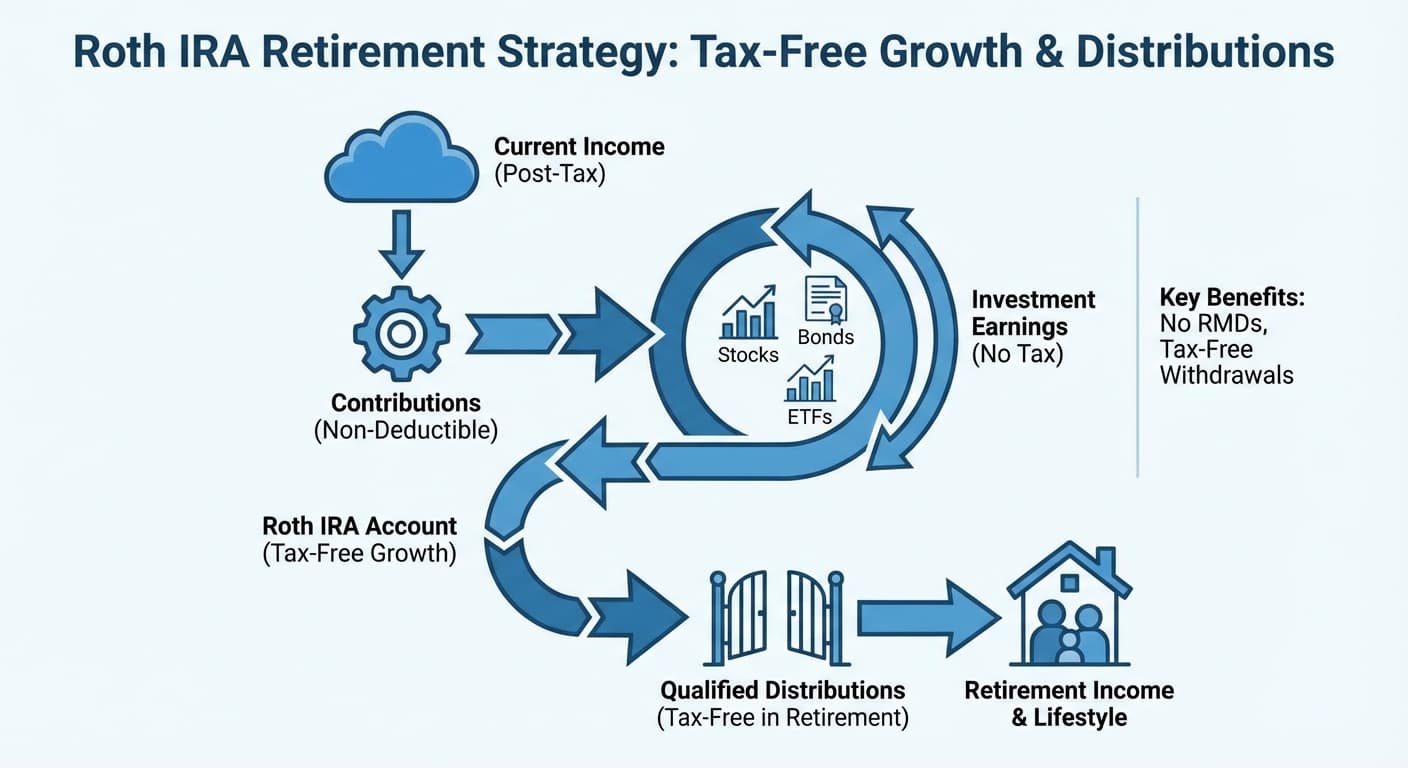
Backdoor Roth IRA conversions allow high-income earners to fund Roth IRAs despite exceeding income limits. Understanding the process, timing, and pro-rata rule prevents unexpected taxes while building tax-free retirement wealth.
Why Backdoor Roth
Direct Roth IRA contributions phase out at $161,000-$176,000 (single) or $240,000-$260,000 (married). Backdoor strategy bypasses limits through non-deductible Traditional IRA contributions followed by Roth conversions.
Step-by-Step Process
Step 1: Contribute to Traditional IRA (non-deductible). Step 2: File Form 8606 documenting non-deductible contribution. Step 3: Convert Traditional IRA to Roth IRA shortly after contribution. Step 4: File Form 8606 showing conversion in the conversion year.
Pro-Rata Rule Trap
If you have existing pre-tax Traditional, SEP, or SIMPLE IRA balances, conversions are partially taxable based on the ratio of pre-tax to after-tax balances across all IRAs. This can eliminate backdoor Roth tax benefits.
Avoiding Pro-Rata Rule
Roll existing Traditional IRA balances into employer 401(k) plans to zero out pre-tax IRA balances before backdoor conversions. Not all 401(k) plans accept incoming rollovers, check plan rules.
Mega Backdoor Roth
Some 401(k) plans allow after-tax contributions beyond standard limits, up to $69,000 total for 2026. Immediately convert after-tax contributions to Roth 401(k) or rollover to Roth IRA for tax-free growth.
Frequently Asked Questions
Q: Is the Backdoor Roth IRA legal?
Yes, it's completely legal and explicitly allowed by IRS rules. The IRS permits non-deductible Traditional IRA contributions regardless of income, and allows conversions from Traditional to Roth IRAs. While Congress has occasionally discussed closing this loophole, it remains legal as of 2026. The IRS even provides specific forms (8606) for documenting these transactions.
Q: What are the income limits for Backdoor Roth IRA?
There are NO income limits for Backdoor Roth IRA because you're making non-deductible Traditional IRA contributions (unlimited income) and then converting to Roth (also no income limit). Direct Roth contributions phase out at $161,000-$176,000 (single) or $240,000-$260,000 (married filing jointly), but Backdoor Roth bypasses these entirely. Anyone at any income level can execute this strategy.
Q: How long should I wait between contribution and conversion?
There's no required waiting period, but best practice is to wait until the contribution settles and posts to your account (typically 1-3 business days), then convert immediately. Waiting minimizes taxable gains between contribution and conversion. Some advisors suggest waiting 30 days or until the next statement to create a clear paper trail, but this isn't legally required and increases the risk of taxable gains.
Q: What is the pro-rata rule and how do I avoid it?
The pro-rata rule forces you to convert a proportional mix of pre-tax and after-tax IRA balances based on ALL your Traditional, SEP, and SIMPLE IRAs combined. If you have $95,000 in pre-tax IRAs and contribute $7,000 after-tax, only 6.8% of your conversion is tax-free—the rest is taxable. Avoid this by rolling existing pre-tax IRA balances into your employer's 401(k) before doing Backdoor Roth conversions, zeroing out pre-tax IRA balances.
Q: Can I do Backdoor Roth if I have a SEP IRA or SIMPLE IRA?
Yes, but the pro-rata rule applies to SEP and SIMPLE IRAs too. If you're self-employed with a SEP IRA, consider switching to a Solo 401(k) which is excluded from pro-rata calculations. For SIMPLE IRAs, you must wait two years after initial contribution before rolling into a 401(k). Alternatively, accept that conversions will be partially taxable based on your total pre-tax IRA balances.
Q: What is Mega Backdoor Roth and how is it different?
Mega Backdoor Roth allows up to $69,000 in Roth contributions annually (vs. $7,000 standard). It requires an employer 401(k) plan that: (1) allows after-tax contributions beyond the $23,000 pre-tax limit, and (2) permits in-service distributions or in-plan Roth conversions. You contribute after-tax dollars to your 401(k), then immediately convert to Roth 401(k) or roll to Roth IRA. Only about 50% of large employer plans offer this feature—check with your HR department.
Q: Do I need to report Backdoor Roth on my tax return?
Yes, you must file Form 8606 for BOTH the contribution year (reporting non-deductible Traditional IRA contribution) and the conversion year (reporting Roth conversion). If you contribute and convert in the same calendar year, file one Form 8606 showing both transactions. Failing to file Form 8606 can result in double taxation—the IRS assumes all IRA money is pre-tax unless you document otherwise. Keep copies of all Forms 8606 permanently.
Q: Can married couples each do a Backdoor Roth?
Yes, each spouse can contribute $7,000 to their own Traditional IRA and convert to their own Roth IRA, for a total of $14,000 annually. Married couples must each file their own Form 8606, but the pro-rata rule applies separately to each spouse's IRAs. If one spouse has large pre-tax IRA balances and the other doesn't, only the spouse without pre-tax IRAs can do tax-free Backdoor Roth conversions.
Conclusion
Backdoor Roth IRA conversions bypass income limits for high earners seeking tax-free retirement growth. Avoid pro-rata rule complications through strategic IRA rollovers, document conversions properly on Form 8606, and consider Mega Backdoor Roth if available.
Use our Tax Calculator to estimate your tax liability and optimize your tax strategy for 2026.