
AMT (Alternative Minimum Tax) Explained 2026
Published on February 2026
Exercised incentive stock options and facing a surprise $50,000 tax bill despite minimal income? You've just encountered the Alternative Minimum Tax—a parallel tax system that traps nearly 200,000 taxpayers annually with bills averaging $15,000 to $100,000.
The problem is AMT operates like a hidden trap. Most taxpayers don't realize they're subject to AMT until filing, when it's too late to adjust. High state taxes, ISO exercises, or even large families can trigger AMT, forcing you to calculate tax twice and pay whichever is higher. The complexity confuses even experienced accountants.
This comprehensive guide demystifies AMT with clear explanations of how it's calculated, which preference items trigger it, who's most at risk, and proven strategies to minimize or avoid AMT entirely. You'll learn exactly when AMT applies and how to plan around it before year-end decisions lock you into unexpected liability.
Alternative Minimum Tax ensures high-income taxpayers pay minimum tax despite deductions and credits. Understanding AMT calculation, preference items, and planning strategies helps avoid unexpected tax bills that can exceed regular tax liability by thousands.
What Is AMT?
AMT is a parallel tax system requiring separate tax calculation. You calculate both regular tax and AMT, then pay whichever is higher. Congress created AMT to prevent wealthy taxpayers from using excessive deductions and credits to eliminate tax liability entirely.
The 2026 AMT exemption is $85,700 for single filers and $133,300 for married filing jointly. These exemptions phase out at higher incomes, expanding AMT exposure. Approximately 200,000 taxpayers pay AMT annually, down from millions before recent tax law changes.
How AMT Calculation Works
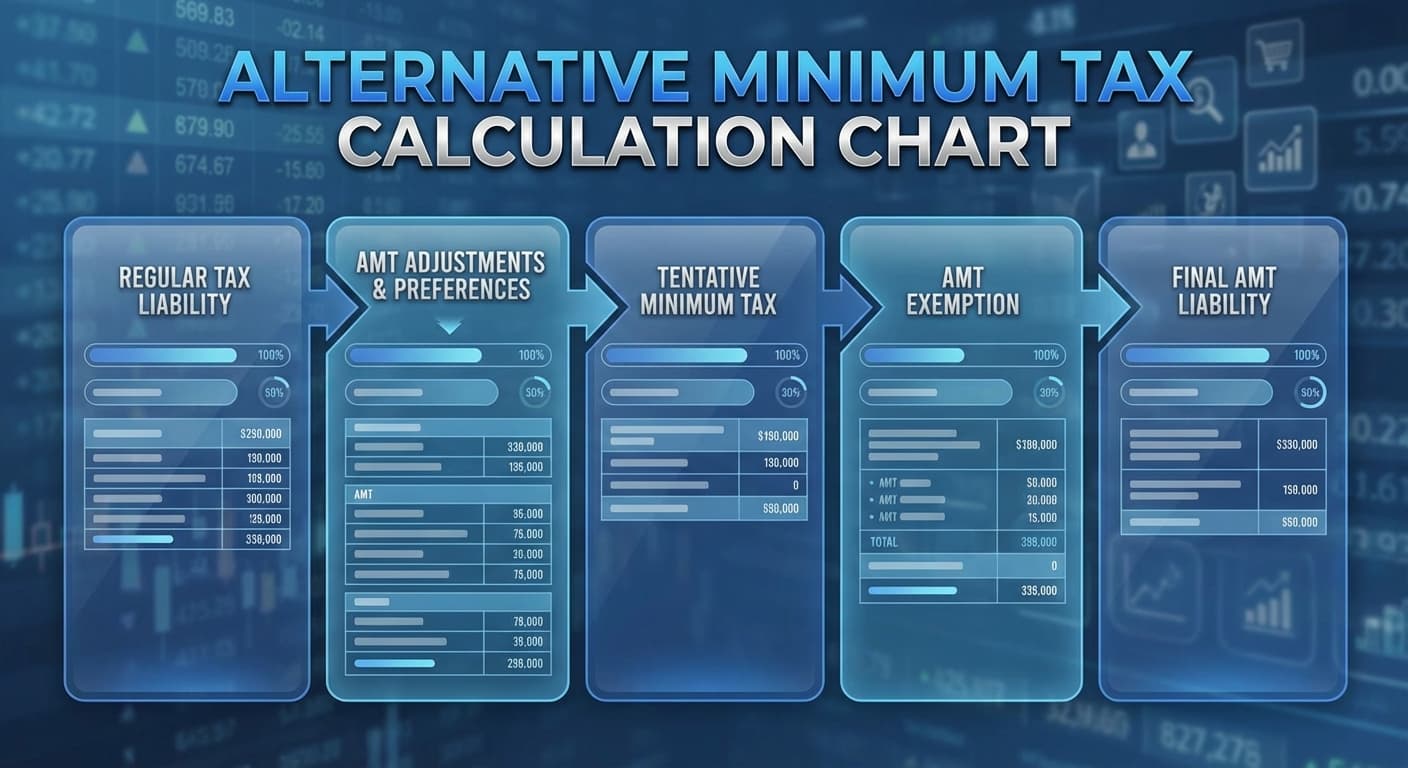
Start with taxable income from your regular tax return. Add back preference items and adjustment items to calculate Alternative Minimum Taxable Income (AMTI). Subtract the AMT exemption amount, then apply AMT tax rates of 26% or 28%.
If your tentative minimum tax exceeds regular tax, you pay the difference as AMT. This additional tax appears on Form 6251 and adds to your total tax liability on Form 1040.
Common AMT Preference Items
State and Local Tax Deductions
State income taxes and property taxes deducted on Schedule A must be added back for AMT. High state tax states like California, New York, and New Jersey create significant AMT exposure. The regular tax allows $10,000 deduction while AMT allows zero.
Incentive Stock Options
Exercising ISOs creates AMT preference equal to the bargain element (fair market value minus exercise price). Large ISO exercises can trigger substantial AMT liability despite receiving no cash. This is the most common AMT trigger for employees.
Private Activity Bonds
Interest from certain municipal bonds financing private activities is tax-free for regular tax but taxable for AMT. Check bond prospectuses to identify AMT bonds and avoid them if concerned about AMT exposure.
Miscellaneous Itemized Deductions
Investment advisory fees, tax preparation fees, and unreimbursed employee expenses allowed under regular tax (subject to 2% AGI floor) are disallowed for AMT. The Tax Cuts and Jobs Act suspended these deductions through 2026, reducing this AMT issue.
AMT Exemption and Phase-Out
The 2026 AMT exemption begins phasing out at $609,350 for single filers and $1,218,700 for married filing jointly. The exemption reduces by 25 cents for each dollar of AMTI above these thresholds, disappearing entirely at higher income levels.
During the phase-out range, your effective AMT rate exceeds the stated 26% or 28% rates because you're losing exemption benefits. This creates a hidden marginal rate spike that can reach 35% in the phase-out zone.
Who Pays AMT?
High-income taxpayers in high-tax states with large state tax deductions face AMT risk. Employees exercising substantial incentive stock options trigger AMT regardless of income level. Large families claiming multiple exemptions also face AMT, though dependent exemptions are currently suspended through 2026.
Income between $200,000 and $1 million creates highest AMT probability. Very high incomes eventually exceed AMT entirely as regular tax rates catch up. Use tax planning software or professionals to calculate AMT exposure before year-end planning.
AMT Credits
Most tax credits reduce both regular tax and AMT. However, some credits like the Foreign Tax Credit have different limitations under AMT, potentially reducing their value. The Child Tax Credit partially offsets AMT liability for families.
AMT paid creates a minimum tax credit (MTC) that can offset future regular tax when AMT doesn't apply. This primarily helps taxpayers who paid AMT due to timing differences like ISO exercises. The credit carries forward indefinitely.
Strategies to Avoid AMT
Time Income and Deductions
Accelerate or defer income and deductions to minimize AMT years. If you're in AMT this year, accelerating income doesn't increase marginal rates. Conversely, defer income to non-AMT years when marginal rates are lower.
Limit ISO Exercises
Exercise ISOs gradually over multiple years to spread AMT impact. Calculate tentative minimum tax before large exercises to avoid unexpected six-figure AMT bills. Consider disqualifying dispositions to eliminate AMT preference at the cost of higher ordinary income rates.
Maximize Exemption
Keep AMTI below phase-out thresholds to preserve full AMT exemption. This may mean deferring income, maximizing 401(k) contributions, or timing capital gains realizations. Small income reductions can generate large tax savings in the phase-out zone.
Review Investment Interest
Investment interest deduction is allowed for both regular tax and AMT, creating opportunities. Consider leveraged investing strategies if you would otherwise pay AMT without the investment interest deduction benefit.
AMT vs Regular Tax Comparison
Regular tax rates range from 10% to 37% with seven brackets. AMT has only two rates: 26% on AMTI up to $220,700 (2026, married filing jointly) and 28% above. This simpler structure can benefit or harm depending on your specific situation.
Regular tax allows standard deduction or itemized deductions. AMT allows neither standard nor itemized deductions, instead using a fixed exemption amount. This fundamental structural difference drives most AMT liability.
Form 6251 Requirements
File Form 6251 if you have AMT preference items or adjustments. The form calculates tentative minimum tax and determines whether you owe AMT. Taxpayers above certain income thresholds must complete Form 6251 even if ultimately not owing AMT.
Tax software automatically triggers Form 6251 when necessary. Manual filers should review Form 6251 instructions to determine filing requirements based on income level and deduction types.
Common AMT Misconceptions
- Myth: Only ultra-wealthy pay AMT. Reality: Middle-class taxpayers with ISOs or high state taxes can owe AMT
- Myth: Charitable donations trigger AMT. Reality: Charity deductions work the same under AMT and regular tax
- Myth: AMT can't be avoided. Reality: Strategic planning significantly reduces AMT exposure
- Myth: All municipal bond interest is AMT-free. Reality: Private activity bonds create AMT income
Frequently Asked Questions
Q: What income level triggers AMT?
There's no single income threshold—AMT depends on your specific situation. Taxpayers earning $200,000-$1,000,000 face highest AMT risk, especially in high-tax states or with large ISO exercises. However, even moderate-income earners can owe AMT if they exercise substantial stock options. The 2026 exemption starts at $85,700 (single) and $133,300 (married), but phases out at higher incomes.
Q: How do I know if I owe AMT?
You must calculate both regular tax and AMT, paying whichever is higher. File Form 6251 to determine AMT liability. Tax software automatically calculates this. Key warning signs include large state tax deductions, exercising incentive stock options, significant investment income, or deducting substantial miscellaneous itemized deductions. If your taxable income exceeds exemption thresholds and you have preference items, calculate AMT.
Q: Can I get a refund if I paid AMT in previous years?
Yes, through the Minimum Tax Credit (MTC). If you paid AMT due to timing differences (like ISO exercises), you can claim a credit against future regular tax when you're not subject to AMT. This credit carries forward indefinitely. However, the MTC only applies to timing-based AMT, not AMT from permanent preference items like state tax deductions. Track your MTC on Form 8801.
Q: What's the difference between AMT and regular tax rates?
Regular tax uses seven brackets (10%-37%) with standard or itemized deductions. AMT uses only two rates—26% on Alternative Minimum Taxable Income (AMTI) up to $220,700 and 28% above—with a fixed exemption instead of deductions. AMT adds back preference items like state taxes and ISO bargain elements, creating a broader tax base. You calculate both and pay the higher amount.
Q: Do incentive stock options always trigger AMT?
Not always, but they're the most common AMT trigger. When you exercise ISOs (but don't sell), the difference between fair market value and exercise price (bargain element) becomes an AMT preference item. Large exercises can create six-figure AMT bills despite receiving no cash. However, if you hold ISOs without exercising, or if your total AMT calculation stays below regular tax, you won't owe AMT. Strategic partial exercises can minimize AMT impact.
Q: Are charitable donations affected by AMT?
No, charitable contributions work identically under both regular tax and AMT. They're not preference items and don't get added back for AMT calculations. This makes charity one of the few deductions that reduces both regular and AMT liability equally. If you're subject to AMT, increasing charitable giving can effectively reduce both tax calculations.
Q: How can I avoid AMT?
Time income and deductions strategically: defer or accelerate income to avoid AMT years. For ISOs, exercise gradually over multiple years instead of large one-time exercises. Maximize retirement contributions to reduce AMTI. Keep income below AMT exemption phase-out thresholds ($609,350 single, $1,218,700 married for 2026). Consider disqualifying ISO dispositions in high AMT years. Work with a tax professional to model scenarios before year-end.
Q: Does living in a high-tax state automatically mean I'll pay AMT?
Not automatically, but it significantly increases risk. State and local taxes (SALT) deducted on Schedule A must be added back for AMT. With the $10,000 SALT cap for regular tax (and $0 for AMT), high-tax states like California, New York, and New Jersey create substantial AMT exposure for middle and upper-income earners. Your total tax picture—including other preference items and income level—determines whether you actually owe AMT.
Conclusion
Alternative Minimum Tax adds complexity to tax planning but careful attention to preference items and strategic timing minimizes exposure. Calculate both regular and AMT tax scenarios before year-end decisions involving ISOs, state tax payments, or large deductions.
Use our AMT Calculator to determine whether you'll owe Alternative Minimum Tax and model planning strategies to reduce liability.